
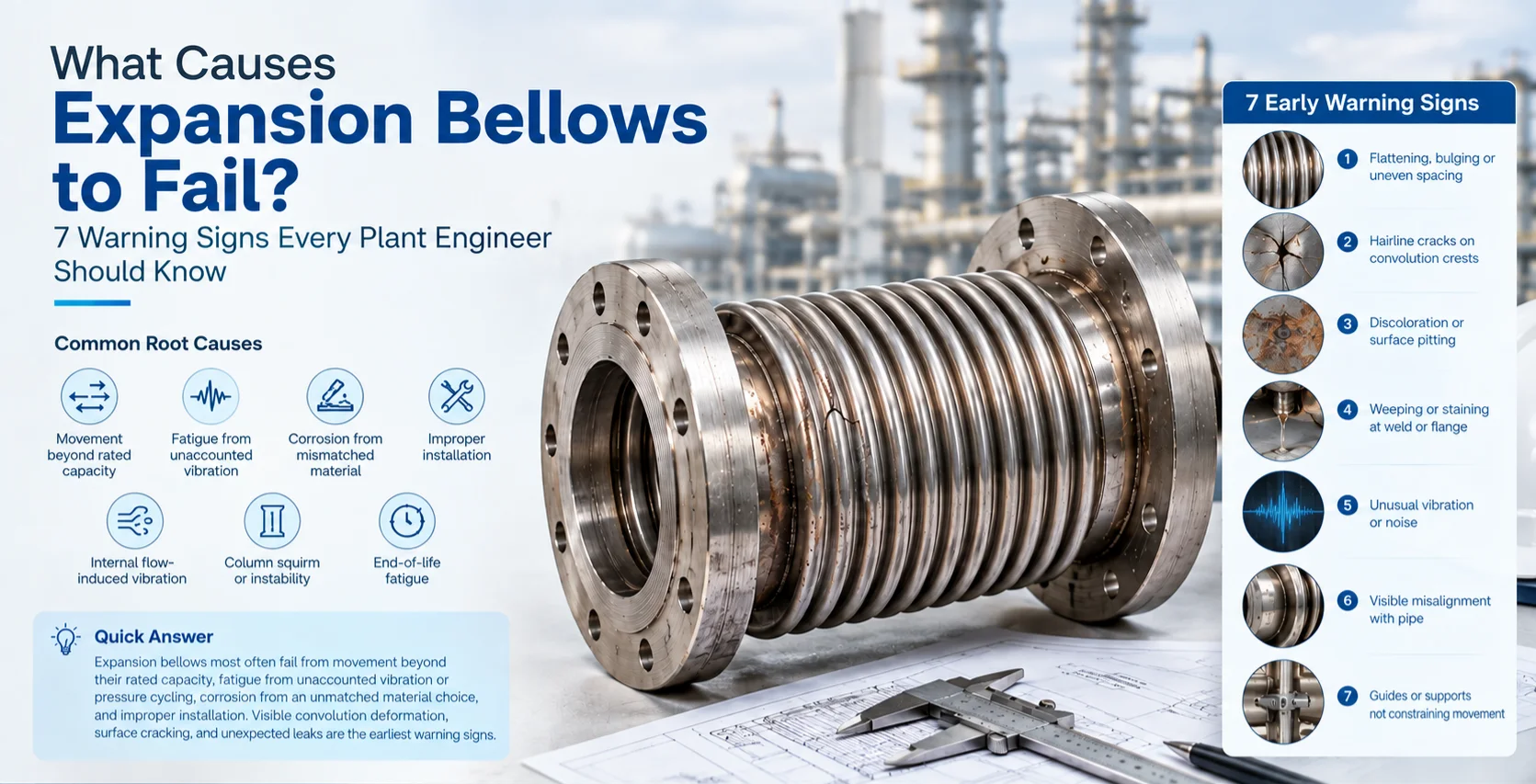

Expansion bellows most often fail from movement beyond their rated capacity, fatigue from unaccounted vibration or pressure cycling, corrosion from an unmatched material choice, and improper installation such as missing guides or misaligned anchors. Visible convolution deformation, surface cracking, and unexpected leaks at the joint are the earliest warning signs.
A bellows fails for a reason — usually a predictable one
Unlike a straight run of pipe, an expansion bellows is designed to flex constantly, which means its failure modes are different from ordinary pipe corrosion or a simple gasket leak. Most bellows failures trace back to one of a small number of root causes, and most of those causes leave visible warning signs before an actual leak or rupture occurs.
The most common root causes
These account for the large majority of premature bellows failures seen in the field.
- Movement beyond rated capacity — the actual axial, lateral, or angular movement of the pipe exceeds what the bellows was designed and calculated for, often because real-world thermal growth wasn’t measured accurately at the design stage.
- Fatigue from unaccounted vibration — mechanical vibration from nearby rotating equipment adds cycles the EJMA fatigue calculation never accounted for, shortening real service life well below the rated figure.
- Corrosion from mismatched material — a bellows material grade that doesn’t match the actual process media or external environment corrodes from the inside, outside, or both, weakening the thin convolution walls faster than expected.
- Improper installation — missing or incorrectly placed pipe guides, misaligned anchors, or a bellows installed under initial strain (rather than at its neutral, cold-set position) all shorten fatigue life regardless of how well the bellows itself was designed.
- Internal flow-induced vibration — high-velocity flow across the convolutions can set up resonant vibration in the bellows itself; this is often solved with an internal liner sleeve at the design stage, and its absence is a common oversight.
- Column squirm or instability — in axial joints under high pressure without adequate restraint, the bellows can buckle sideways rather than compress uniformly, concentrating stress and accelerating failure.
- Simple end-of-life fatigue — even a correctly designed and installed bellows has a finite rated cycle life; running well past it without inspection is its own risk factor.
Early warning signs to look for during routine inspection
Catching these before a shutdown-causing failure is far cheaper than an unplanned outage.
- Visible flattening, bulging, or uneven spacing between convolutions
- Hairline cracks on the convolution crests, often starting at a weld seam
- Discoloration or surface pitting suggesting corrosion attack
- Any weeping or staining at the bellows-to-pipe weld or flange connection
- Unusual vibration or noise from the joint during operation
- Visible misalignment of the bellows relative to the connecting pipe
- Guides or supports around the bellows showing signs they’re not constraining movement as intended
Reducing failure risk starts before installation
Most of the failure causes above are design-and-installation issues, not manufacturing defects — which means the highest-leverage fix is accurate movement and vibration data going into the original specification, correct guide and anchor placement during installation, and periodic visual inspection during planned maintenance windows rather than waiting for a failure to force one.
A visual inspection during each planned maintenance shutdown is a reasonable baseline for most industrial installations, with more frequent checks for bellows operating near their rated pressure, temperature, or cycle limits, or in visibly corrosive environments.
Minor external issues like a damaged liner or a loose guide can sometimes be corrected in place, but cracked or corroded convolution walls generally cannot be safely repaired and call for replacement, since the thin-walled bellows section is the primary pressure boundary.
Any leak at a pressure-retaining component should be treated seriously and assessed promptly, but the urgency depends on the process media, pressure, and location — flag it to your safety and maintenance procedures rather than making a case-by-case judgment call in the field.
Seeing early warning signs on an installed bellows? Contact MechFlex Bellows for an inspection consultation and replacement lead times before it becomes an unplanned shutdown.