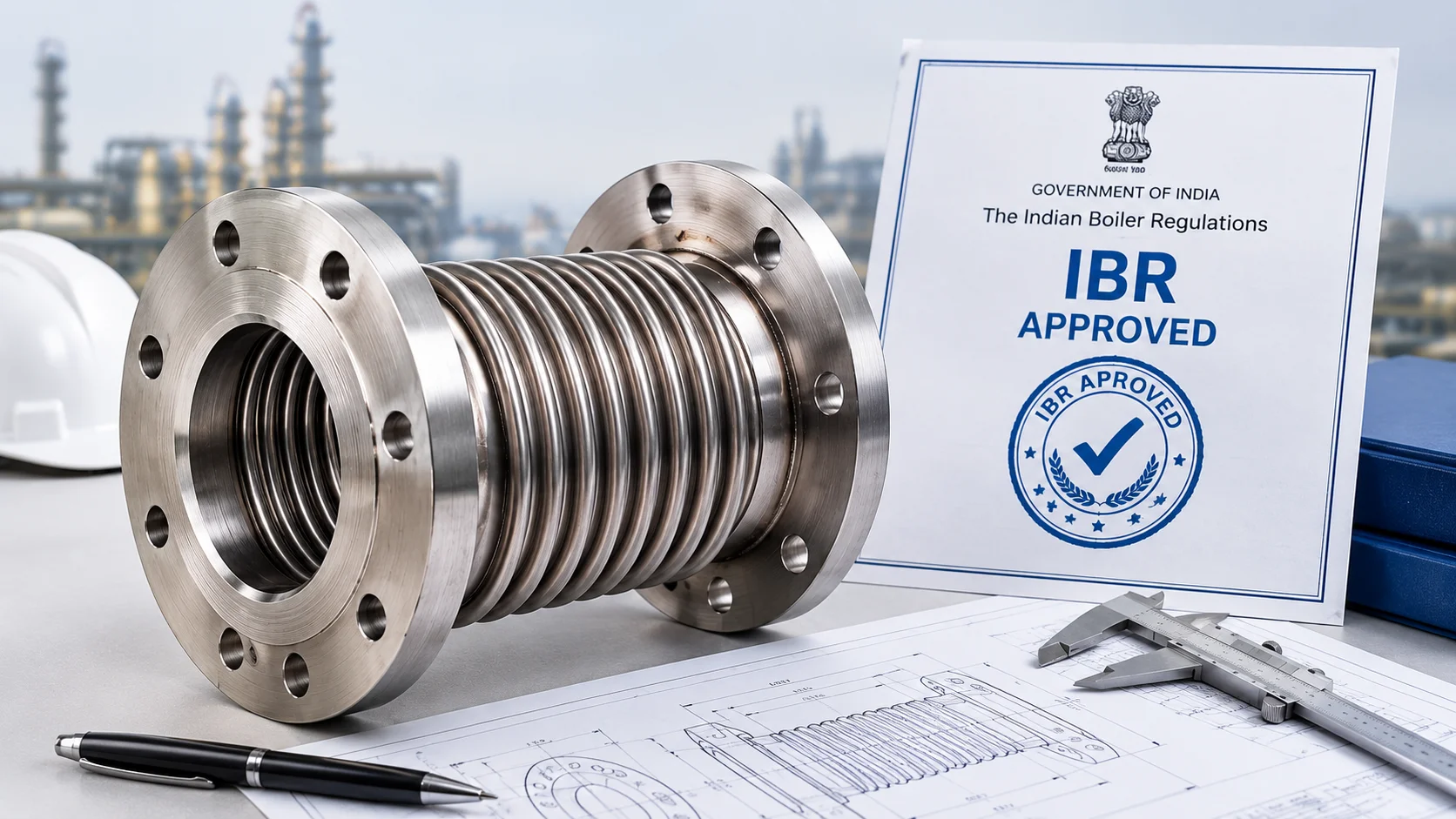


Bellows material choice mainly comes down to three factors: operating temperature, the process media the bellows will contact, and corrosion exposure from the surrounding environment. SS304 covers most general industrial duty, SS316 adds resistance for chloride-exposed or more corrosive environments, and specialty alloys are reserved for extreme temperature or highly corrosive chemical service.
Why material choice is not a formality
It’s tempting to treat bellows material as a line item to fill in after the mechanical design is settled. In practice, material selection affects fatigue life as much as geometry does — a bellows made from the wrong grade of steel for its service conditions can crack from stress-corrosion or pitting long before it reaches its designed cycle life, even if the movement rating was calculated correctly.
Three questions decide most material selections: how hot does it get, what is actually flowing through the pipe, and what’s in the surrounding air or ground that could attack the metal from outside.
Stainless steel: the default for good reason
SS304 stainless steel is the standard starting point for general industrial expansion bellows — water, steam, compressed air, and many non-aggressive process gases. It offers a good balance of formability (important for the thin-walled corrugations a bellows needs), strength, and corrosion resistance for the majority of plant utility and process applications.
SS316 steps up from there specifically for chloride exposure — coastal plants, marine environments, chemical processing lines carrying chloride-containing media, and any application where SS304 would be prone to pitting or stress-corrosion cracking over time. The molybdenum content in SS316 is what gives it that extra resistance.
When to look beyond standard stainless
High-temperature applications — furnace exhaust, kiln ducting, and some power plant duty — can exceed what standard austenitic stainless steels handle reliably long-term, pushing the specification toward heat-resistant alloys or requiring a design review of wall thickness and convolution geometry to compensate. Highly aggressive chemical service (strong acids, certain solvents) may call for nickel alloys or other specialty grades entirely.
The general principle: as temperature and corrosion severity increase, so does the cost and lead time of the correct material — which is exactly why guessing conservatively ‘just to be safe’ with an over-specified exotic alloy, or under-specifying to save cost, both create problems. The right answer is matching the grade to the actual documented service conditions.
What to hand your supplier before they quote
A material recommendation is only as good as the operating data behind it.
- Operating and design temperature (not just ambient — peak transient temperatures matter for fatigue)
- The process media in contact with the bellows, including any trace contaminants (chlorides, sulfur compounds, etc.)
- External environment — coastal, industrial-corrosive, or standard indoor conditions
- Design pressure and expected pressure cycling, since material behavior under fatigue is temperature- and stress-dependent
Not necessarily — SS316 costs more and isn’t required where SS304’s corrosion resistance already matches the service conditions. Specifying SS316 everywhere by default adds cost without adding value in applications that don’t involve chloride exposure or aggressive media.
Sometimes, but it’s not guaranteed to be a simple swap — wall thickness and convolution profile calculations are material-dependent under EJMA formulas, so a material change can require re-checking the fatigue life and spring rate calculations.
Specifying based on the pipe material rather than the bellows’ actual service conditions. A bellows flexes constantly in a way straight pipe doesn’t, so it needs its own material evaluation even when the connecting pipework is a standard grade.
Send MechFlex Bellows your temperature, media, and environment details — we’ll recommend the material grade that matches your actual operating conditions, not a generic default.