
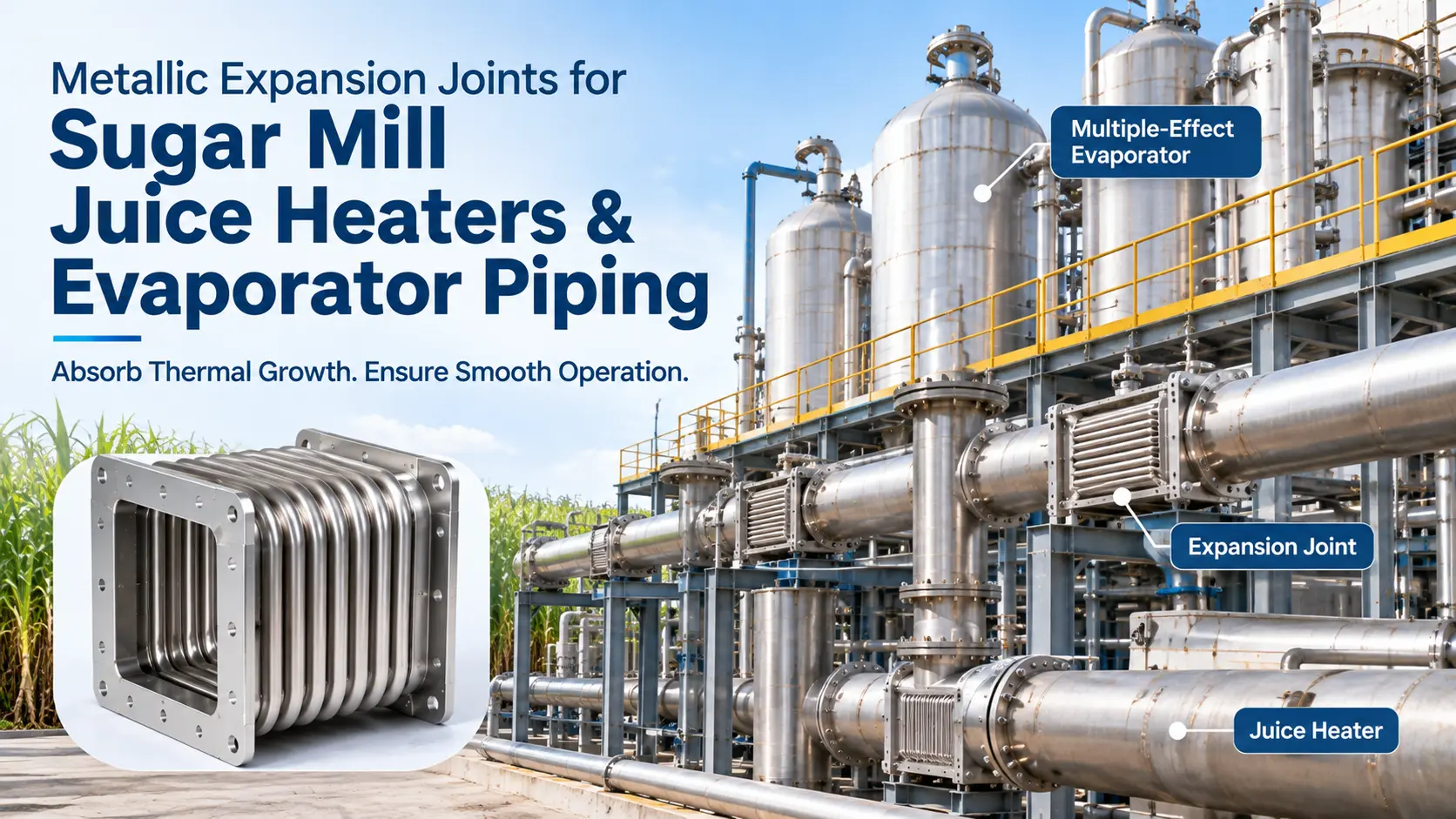

Multiple-effect evaporators and juice heaters in sugar mills move vapor and condensate through interconnected piping that needs metallic expansion joints to absorb thermal growth across each effect’s temperature stage, distinct from the boiler-side exhaust bellows covered elsewhere in this content plan.
The juice concentration side of a sugar mill
Beyond the bagasse-fired boiler and cogeneration turbine covered elsewhere in this content plan, a sugar mill’s process side runs its own significant piping network: juice heaters raise extracted cane juice to the temperature needed for clarification, and multiple-effect evaporators then concentrate that clarified juice into syrup by boiling it down across a series of vacuum stages, each operating at a progressively lower pressure and temperature than the one before.
Where metallic expansion joints are used
Each stage of this process presents its own piping movement to manage.
- Juice heater steam and condensate piping — absorbing thermal growth as heaters bring juice up to clarification temperature using steam, often bled from the mill’s turbine or boiler system
- Inter-effect vapor piping — connecting each evaporator effect to the next, where the vapor from one effect becomes the heating medium for the following effect at a lower pressure
- Condensate return piping — returning condensate from the evaporator train back toward the boiler feedwater system, spanning meaningful distance and thermal movement across a typical mill layout
Why each evaporator effect needs its own consideration
Because each effect in a multiple-effect evaporator train operates at a different pressure and temperature by design, the expansion joints connecting each stage can’t be specified with a single blanket figure for the whole train — movement, pressure, and temperature should be confirmed effect by effect, similar in principle to how refinery process units or cement plant duct locations are each treated individually elsewhere in this content plan.
What to specify
Operating pressure and temperature for each specific effect or heater stage, expected movement based on the piping layout between stages, and whether IBR jurisdiction applies to any boiler-connected steam supply feeding the juice heaters.
Each effect in a multiple-effect evaporator operates at a different pressure and temperature by design, so the expansion joints connecting each stage need movement and material calculated against that specific stage’s actual operating conditions rather than a single blanket figure.
Often yes — many sugar mills use bled or extraction steam from their own turbine or boiler system to supply juice heaters, which ties the heater piping’s design conditions back to the mill’s overall steam balance.
It can be, if the steam supply to the juice heaters is connected to boiler piping falling within IBR’s defined jurisdiction — confirm scope with your project’s boiler classification rather than assuming it applies uniformly.
Mapping expansion joint needs across your evaporator train or juice heating system? Send MechFlex Bellows your stage-by-stage pressure and temperature data for tailored recommendations.