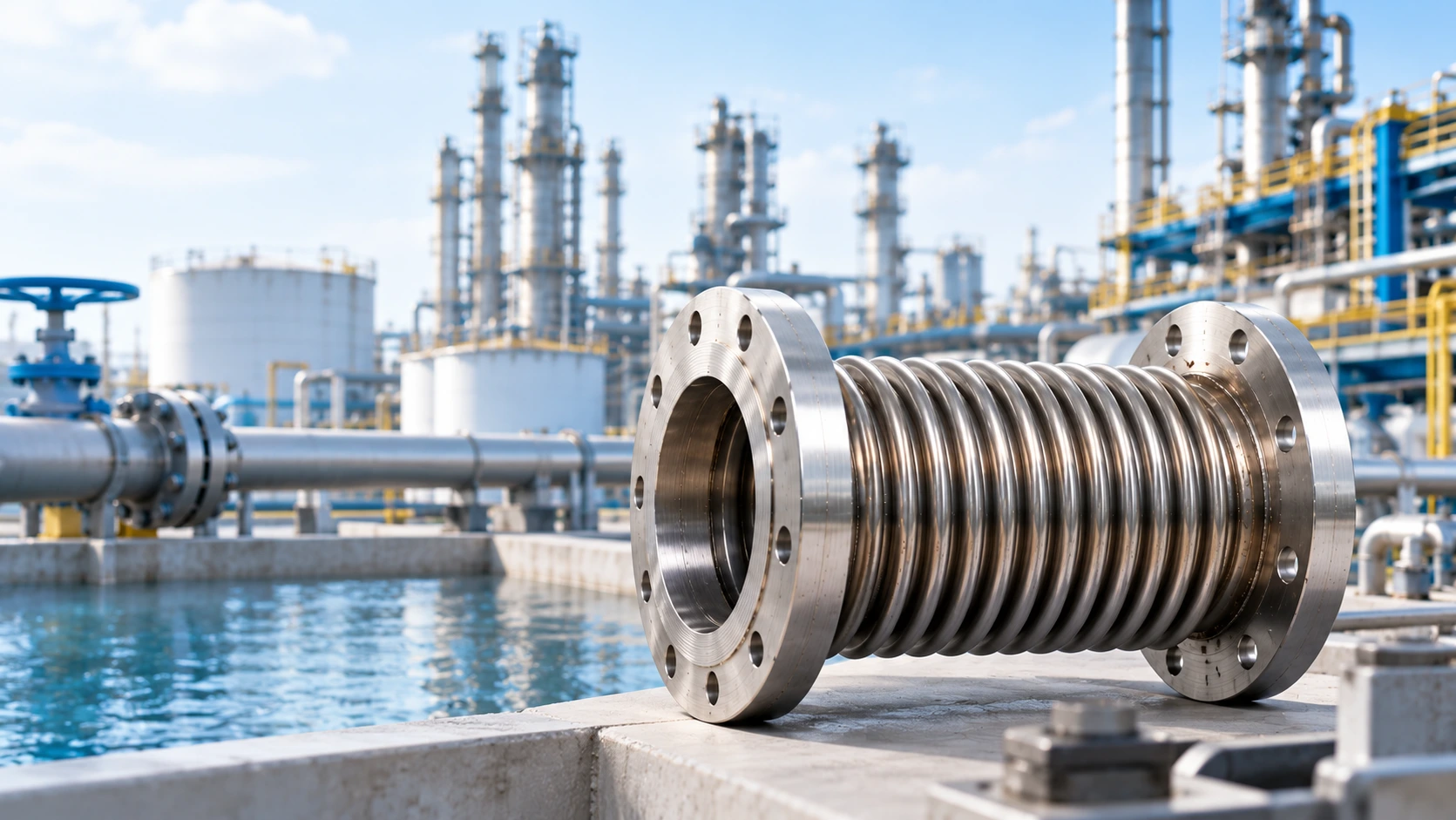

Metallic expansion bellows in chemical process piping absorb thermal growth across reactors, distillation columns, and transfer lines, with material selection — often SS316 or specialty alloys rather than standard SS304 — carrying as much design weight as the movement calculation itself, given how many chemical process streams are corrosive to standard materials.
Round pipe, corrosive contents
Most chemical process piping — reactor connections, distillation and heat exchanger lines, transfer piping between vessels — is round pipe, making metallic expansion bellows (as distinct from the rectangular ducting used for scrubber and fume extraction systems) the standard product for absorbing thermal movement in these lines. What sets chemical service apart from general industrial piping is what’s actually flowing through that pipe.
Where bellows are used across chemical process piping
Several distinct points in a typical chemical plant rely on metallic expansion bellows.
- Reactor vessel connections — absorbing thermal cycling as batch or continuous reactions bring the vessel through its process temperature range
- Distillation column and reboiler piping — thermal growth across piping that spans significant temperature differences between column sections
- Heat exchanger inlet/outlet connections — protecting exchanger nozzles from imposed pipe loads as connected piping expands
- Transfer lines between vessels — absorbing movement where long pipe runs connect process equipment across a plant layout
Why material selection dominates the specification
A bellows correctly sized for movement and pressure can still fail early if its material doesn’t match the actual process media — acids, alkalis, solvents, and reactive intermediates can attack standard SS304 far faster than the thin convolution walls were designed to tolerate. SS316 handles a wide range of chemical exposure, but certain concentrated acids, high-chloride streams, and specific solvents exceed even its resistance, pushing toward higher-nickel alloys or other specialty grades reviewed against the documented process chemistry.
What to specify
Full process media composition including trace contaminants, concentration and temperature together (since corrosion rate rarely depends on either alone), design pressure and expected cycling from batch or continuous operation, and whether the bellows will see intermittent cleaning or purge cycles with different chemistry than normal operation.
It covers a wide range of chemical process exposure well, but certain concentrated acids, high-chloride streams, or specific solvents can exceed its resistance — confirm against your actual documented process media rather than assuming SS316 is universally sufficient.
Batch processes take the reactor and connected piping through repeated heating and cooling cycles tied to the batch schedule, and each cycle adds to the bellows’ fatigue count — cycle life should be calculated against the real batch frequency, not just peak process temperature.
Yes — if cleaning or purge chemistry differs from normal process media, the bellows material needs to be compatible with both, since intermittent exposure to a more aggressive chemical can still drive corrosion over the equipment’s service life.
Working with corrosive process media in reactor, column, or transfer line piping? Share your media data with MechFlex Bellows for a material-matched metallic expansion bellows recommendation.