
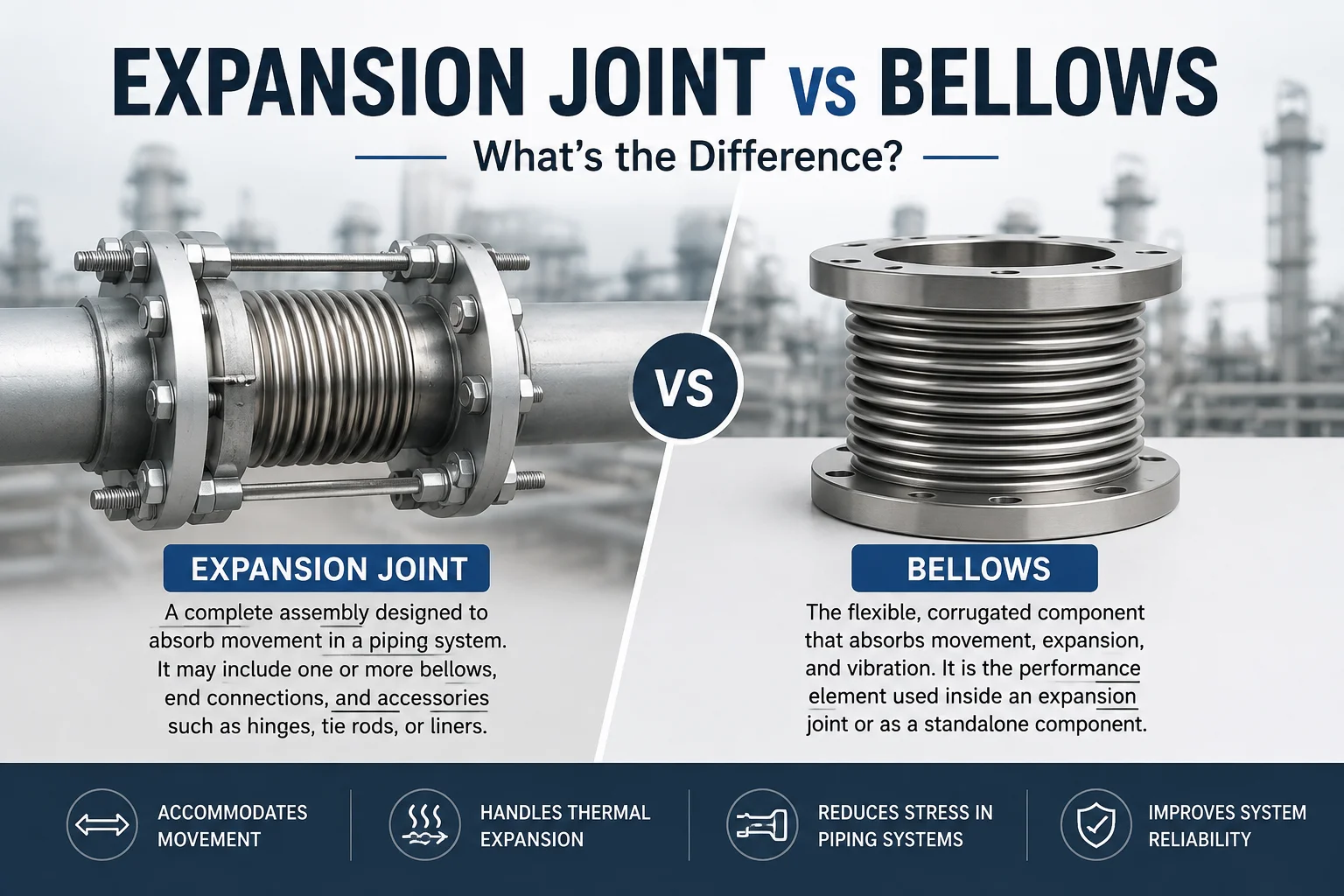

Expansion joints and bellows are often used interchangeably, but they are not always technically the same. A bellows is the flexible corrugated component designed to absorb movement, while an expansion joint is a complete assembly that may include one or more bellows along with end connections, liners, covers, tie rods, hinges, or other accessories.
Expansion Joint vs Bellows
| Feature | Bellows | Expansion Joint |
|---|---|---|
| Basic meaning | Flexible corrugated component | Complete assembly containing one or more bellows |
| Main function | Absorbs movement and deformation | Accommodates movement within a piping or ducting system |
| Construction | Usually corrugated and flexible | Bellows plus end connections and accessories |
| Components | Bellows element | Bellows, flanges, pipes, restraints, liners or covers |
| Movement | Depends on design | Axial, lateral and/or angular movement |
| Application | Used as a flexible component | Used as an engineered piping or ducting solution |
| Customization | Material, dimensions and corrugations | Complete design based on system requirements |
What Is a Bellows?
A bellows is the flexible component of an expansion system that is designed to accommodate movement caused by thermal expansion, vibration, pressure changes, or mechanical displacement. Metallic bellows are commonly manufactured with corrugations that allow controlled flexibility while maintaining the required strength and pressure resistance.
What Is an Expansion Joint?
An expansion joint is a complete engineered assembly designed to accommodate movement within industrial piping or ducting systems. Depending on the application, it may include one or more bellows together with end connections, flanges, liners, covers, tie rods, hinges, or other restraint components.
When Is the Term “Bellows” Used?
The term bellows is commonly used to describe the flexible corrugated element of an expansion joint. Depending on the industry and application, similar products may be referred to as Metallic Expansion Bellows, Expansion Bellows, or Bellows Expansion Joints. While the terminology may overlap, the complete expansion joint can include additional components designed to control movement and manage system forces.
Types of Expansion Joints
Industrial expansion joints are available in different designs depending on the type and direction of movement required. Common types include:
- Axial Expansion Joints for longitudinal pipe movement
- Universal Expansion Joints for lateral movement
- Gimbal Expansion Joints for multi-plane angular movement
- Single and Universal Hinge Expansion Joints for controlled angular movement
- Inline Pressure Balance Expansion Joints for managing thermal movement and pressure thrust
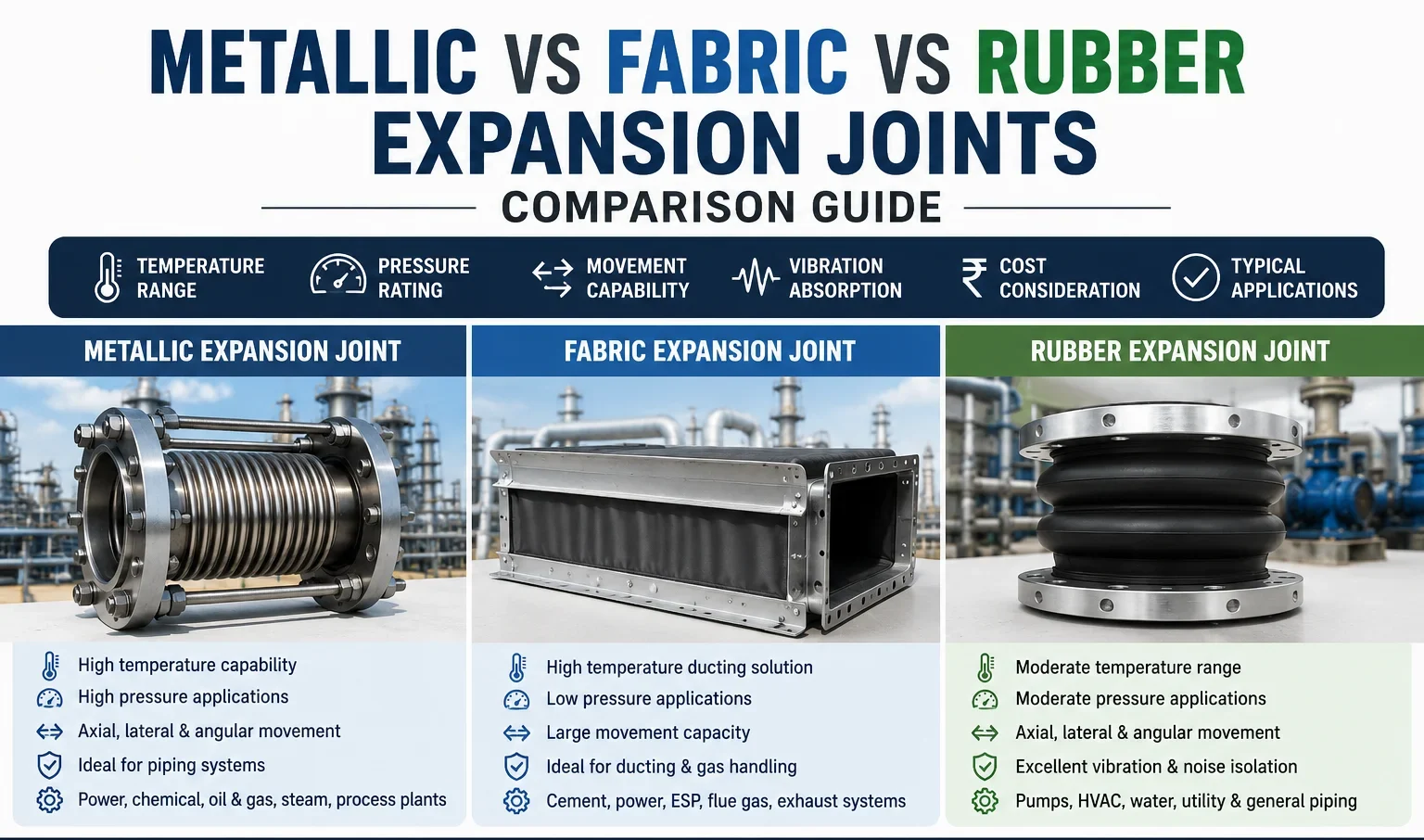
- Fabric Expansion Joints for high-temperature ducting systems
- Rubber Expansion Joints for vibration and noise isolation
How to Choose the Right Expansion Joint
Selecting the right expansion joint depends on several operating and installation factors, including:
- Operating temperature and pressure
- Required axial, lateral, or angular movement
- Pipe or duct size
- Type of media being handled
- Material compatibility
- Available installation space
- Pressure thrust and restraint requirements
- Overall system and operating conditions
A bellows can be the primary flexible component of an expansion joint, but an expansion joint is generally a complete assembly that may include additional components and restraints.
Depending on its design, an expansion joint can accommodate axial, lateral, angular, or combined movement.
No. Metallic bellows are typically used in piping and pressure applications, while fabric expansion joints are commonly used in ducting and gas-handling systems.



Leave A Comment