
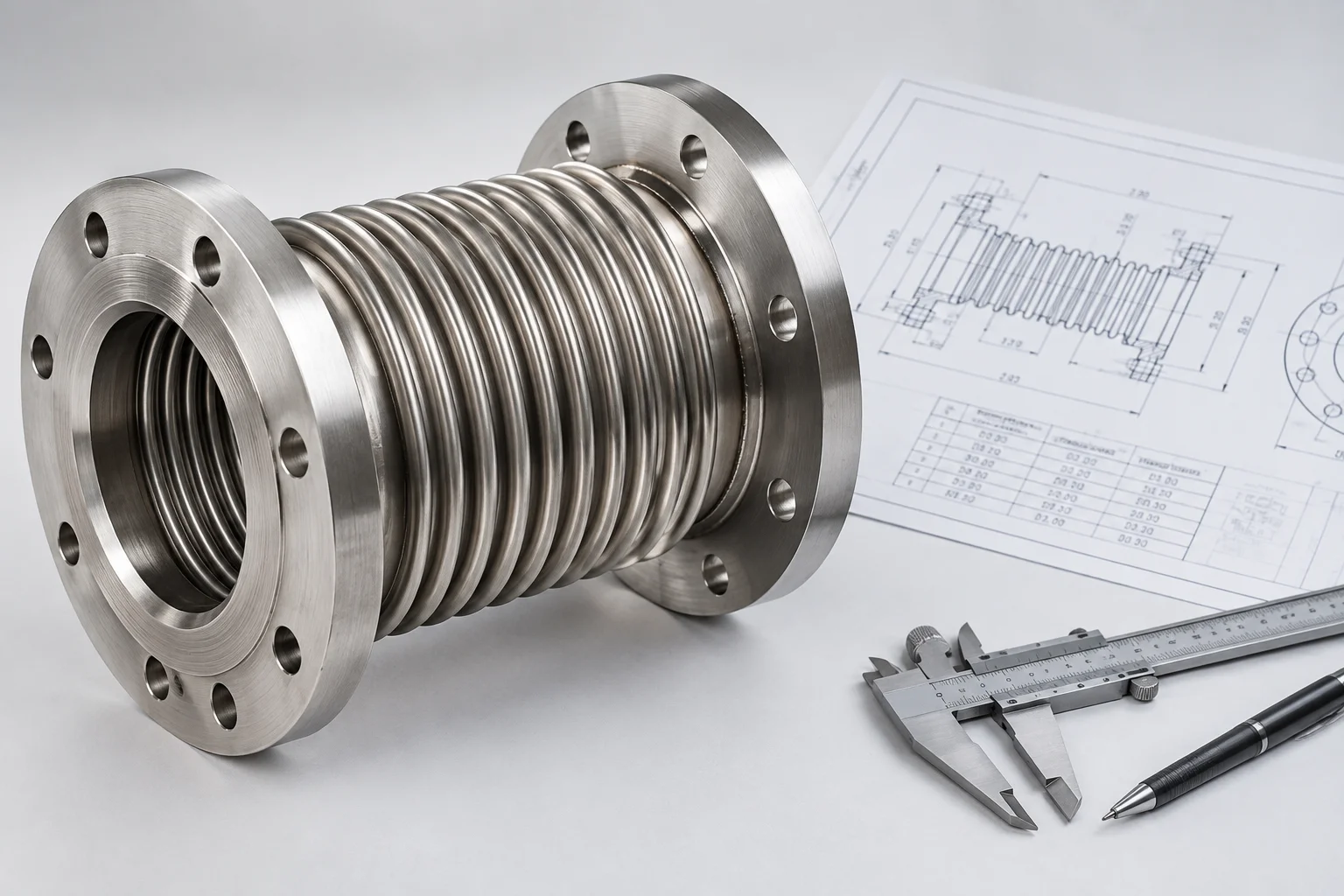

There’s no single price list for expansion bellows and expansion joints — and that’s not evasiveness on a manufacturer’s part, it’s because the cost genuinely depends on a combination of factors specific to each application. If you’re researching pricing before requesting a quote, here’s what actually drives the cost up or down.
1. Material Grade
Material is usually the single biggest cost driver. Standard stainless steel grades like SS304 cost less than higher-alloy grades like SS316L or Inconel, which are specified for more corrosive or higher-temperature environments. Non-metallic options — fabric and rubber expansion joints — follow a different cost structure entirely, driven by the specific fabric layers or elastomer compound required for the application’s temperature and chemical exposure.
2. Size (Nominal Bore / Diameter)
Larger diameters require more material, more complex forming, and often more robust reinforcement — cost typically scales with size, but not always linearly, since very large or very small custom diameters can both carry a premium versus standard, commonly-manufactured sizes.
3. Pressure and Temperature Rating
A bellows rated for higher pressure needs thicker walls, more convolutions, or additional reinforcement (like equalizing rings) to safely handle the load — all of which add material and fabrication cost. Higher-temperature applications may also require higher-grade materials, compounding the cost with the material factor above.
4. Movement Type and Capacity
Simple axial movement is generally the least complex (and least costly) to engineer. Joints designed for combined axial + lateral movement (universal), angular movement (gimbal, hinge types), or very large total movement typically cost more, since they require additional components — tie rods, hinges, pipe spools — beyond a standard bellows.
5. Shape and Fabrication Complexity
Round bellows are the most standardized shape to manufacture. Rectangular and square bellows require custom corner fabrication and reinforcement calculated for the specific aspect ratio, which generally adds cost and lead time compared to an equivalent round bellows.
6. Quantity and Standardization
A one-off custom design costs more per unit than an order for multiple identical units, since tooling and design work amortize across the batch. If your application allows some flexibility on exact specifications, matching an existing standard design can reduce both cost and lead time versus a fully custom one.
7. Certification and Testing Requirements
Applications requiring specific certifications, material test certificates (MTCs), third-party inspection, or radiography/hydro-testing documentation add cost beyond the physical component itself — factor this in early if your project requires it, since retrofitting certification after fabrication isn’t usually possible.
Getting an Accurate Quote
Because of how many variables affect the final price, the fastest way to get an accurate number is to share your actual application details rather than asking for a general price range. At minimum, a useful quote request should include:
- Application/industry (e.g., cement plant duct, chemical process piping)
- Nominal size and shape (round, rectangular, square)
- Operating pressure and temperature
- Required movement (axial, lateral, angular — and how much)
- Material preference, if known, or the process media if not
- Quantity required
Because the factors above mean two expansion bellows that look similar in a photo can have very different costs depending on material, pressure rating, and movement requirements — a general price list would be misleading rather than helpful.
Not necessarily — if your requirements happen to match an existing standard design, you avoid the tooling and engineering cost of a fully custom part. It’s worth asking your supplier whether your application fits a standard size before assuming custom is required.
This varies by manufacturer and how complete the application details provided are — quotes with full specifications (size, pressure, temperature, movement, material) are generally faster to turn around than requests needing follow-up questions first.
MechFlex Bellows provides custom quotes based on your specific application requirements. Contact us with your size, pressure, temperature, and movement requirements for a quote, or download our brochure to review our full product range first.