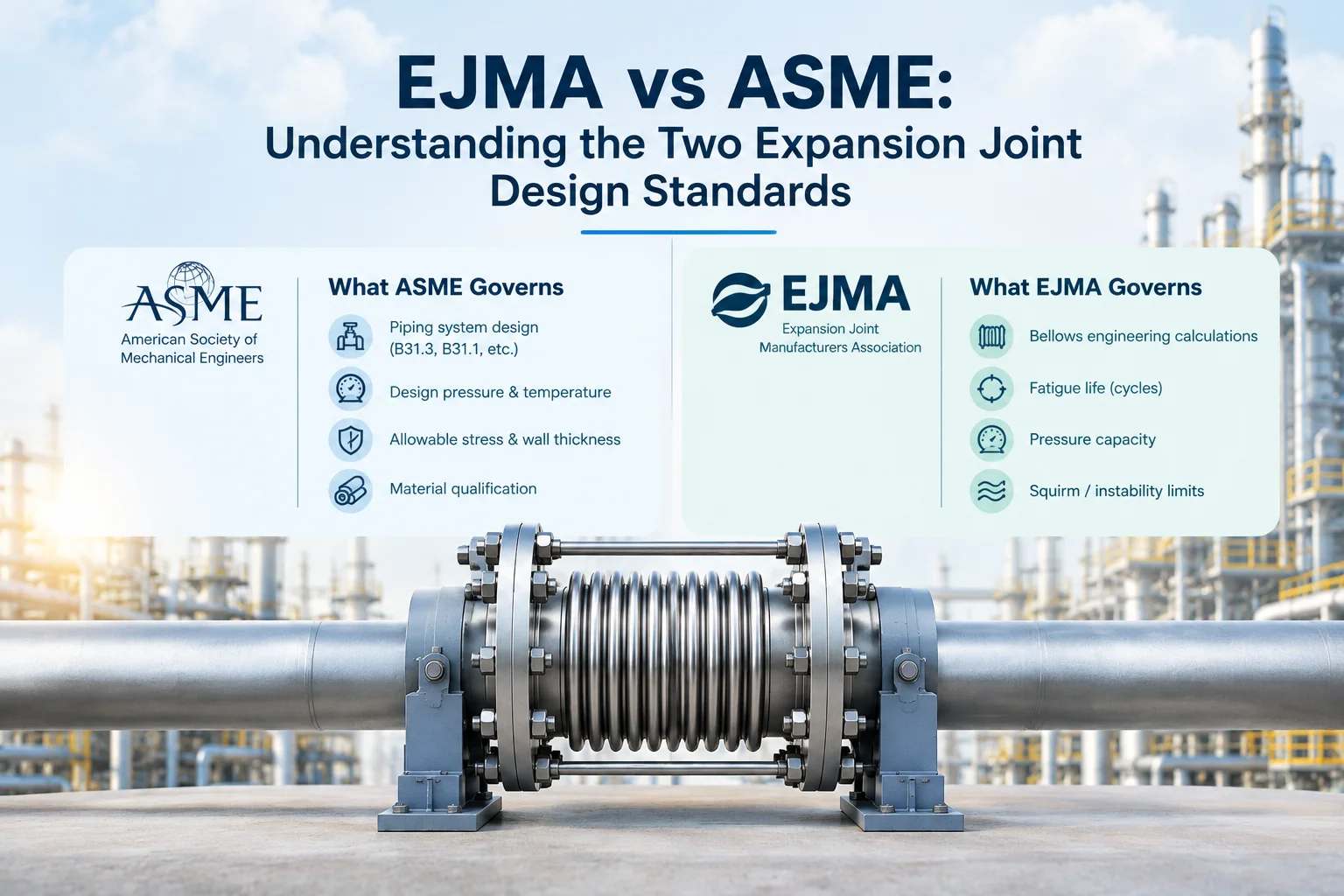

EJMA and ASME are not competing standards — they cover different parts of the same piping system. ASME codes (such as B31.3 and Section VIII) govern the design of the piping and pressure vessels themselves, while EJMA specifically governs the engineering calculations for metal bellows expansion joints that sit within that piping.
Two standards, often confused, rarely competing
Buyers comparing quotations sometimes see one supplier reference EJMA and another reference ASME and assume they’re being offered two different approaches to the same problem. In reality, a properly engineered expansion joint installation should satisfy both — they answer different questions.
What ASME governs
ASME (American Society of Mechanical Engineers) publishes a family of codes covering piping and pressure equipment broadly — ASME B31.3 for process piping, ASME B31.1 for power piping, and the ASME Boiler and Pressure Vessel Code (Section VIII) for pressure vessels, among others. These codes set the rules for the piping system as a whole: allowable stress, wall thickness, material qualification, and system-level design pressure and temperature ratings.
What EJMA governs
EJMA (Expansion Joint Manufacturers Association) is narrower and more specific: its standard covers the bellows element itself — how to calculate spring rate, fatigue life in cycles, pressure capacity, and squirm/instability limits for a corrugated metal bellows undergoing repeated flexing. It doesn’t set piping system-wide stress allowables the way ASME does; it’s the engineering method for the one component that flexes.
How they work together in practice
A piping system is typically designed to an ASME code, which establishes the system’s design pressure, temperature, and allowable stress. The expansion joint installed within that system is then engineered to EJMA formulas using those same design pressure and temperature values as inputs, so its calculated movement capability, spring rate, and fatigue life are valid for the conditions the surrounding piping was actually designed for.
In other words: ASME tells you what the system as a whole is rated for; EJMA tells you what the flexible element inside that system can actually do at those ratings. A spec sheet or quotation that references only one of the two is incomplete — ask for both when evaluating a proposal for a pressure piping project.
No — they aren’t alternatives. A correctly engineered installation uses ASME codes for the overall piping/pressure system design and EJMA formulas for the bellows expansion joint within it.
EJMA. Fatigue life in cycles is calculated using EJMA’s bellows-specific formulas, based on the pressure, temperature, and movement values that come from the ASME-designed piping system it’s installed in.
Not on its own for the bellows element specifically — ASME codes don’t include the detailed bellows fatigue and spring-rate formulas that EJMA provides, so a bellows-specific engineering basis should reference EJMA in addition to the system’s ASME design code.
Ask MechFlex Bellows for both the ASME design basis and the EJMA fatigue calculation behind your next expansion joint quotation.