
ANFD (Agitated Nutsche Filter Dryer) bellows are specialized flexible connections used inside pharmaceutical and fine chemical filter-dryer equipment, where hygienic design, cleanability, and compatibility with GMP (Good Manufacturing Practice) requirements matter as much as the mechanical movement they absorb.
A different kind of bellows application
Most expansion bellows discussed in industrial piping exist to absorb thermal or mechanical movement in a pipe run. ANFD bellows serve a related but distinct purpose: they’re used within Agitated Nutsche Filter Dryer equipment — a common piece of process machinery in pharmaceutical, fine chemical, and specialty chemical manufacturing used to filter and dry a product batch inside a single sealed vessel — where the bellows accommodates the movement of the agitator or lid mechanism while maintaining a hygienic, contamination-free seal.
Why hygienic design is the defining requirement
In pharmaceutical processing, the bellows isn’t just a mechanical component — it’s part of the product-contact or near-product-contact boundary in many ANFD configurations, which means design choices that would be irrelevant in a steam line become critical here.
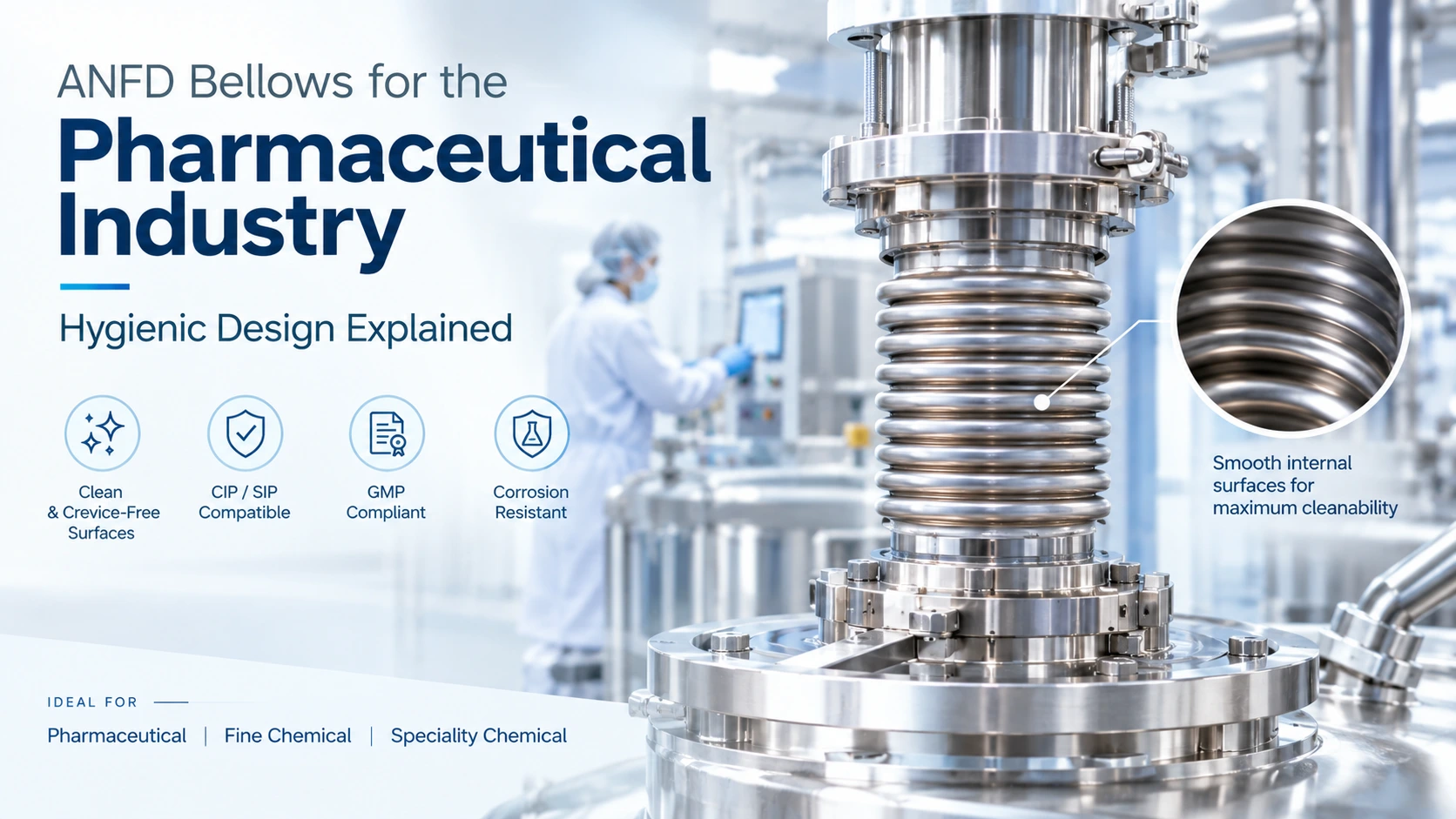
- Smooth, crevice-free internal surfaces that don’t trap residue between production batches
- Material compatibility with cleaning-in-place (CIP) and sterilization-in-place (SIP) chemical and thermal cycles
- Construction that supports the validation and documentation practices GMP environments require
- Corrosion resistance suited to the specific solvents and active pharmaceutical ingredients the equipment will process
Material and construction considerations
Stainless steel — typically higher grades such as SS316 or SS316L, chosen for both corrosion resistance and surface finish quality — is the standard material base for ANFD bellows, with surface finish (often specified to a defined roughness value) as important as the underlying grade for cleanability. Welding and joint design also matter more here than in general industrial bellows, since any crevice or poorly finished weld becomes a potential contamination or cleaning-validation failure point in a pharmaceutical audit.
What to specify for ANFD and pharmaceutical bellows
In addition to the movement, pressure, and temperature data needed for any bellows, a pharmaceutical or ANFD application should specify required surface finish, material certification and traceability documentation needed for GMP validation, CIP/SIP chemical exposure and temperature cycles the bellows will face during routine cleaning, and any specific product-contact material approvals required by the end client’s regulatory framework.
They share the same basic flexing principle, but ANFD bellows are engineered specifically for hygienic pharmaceutical and fine chemical processing equipment, with surface finish, cleanability, and material documentation requirements that go beyond typical industrial-duty bellows.
Requirements vary by end client and application, but pharmaceutical-grade equipment commonly specifies a defined surface roughness value to support cleanability and CIP validation — confirm the exact requirement with your process engineering team before ordering.
Yes — pharmaceutical and GMP-regulated buyers should request material test certificates and traceability documentation as standard practice for equipment that will undergo regulatory validation.
Sourcing bellows for ANFD or other pharmaceutical process equipment? Talk to MechFlex Bellows about hygienic surface finish and documentation requirements for your GMP validation.