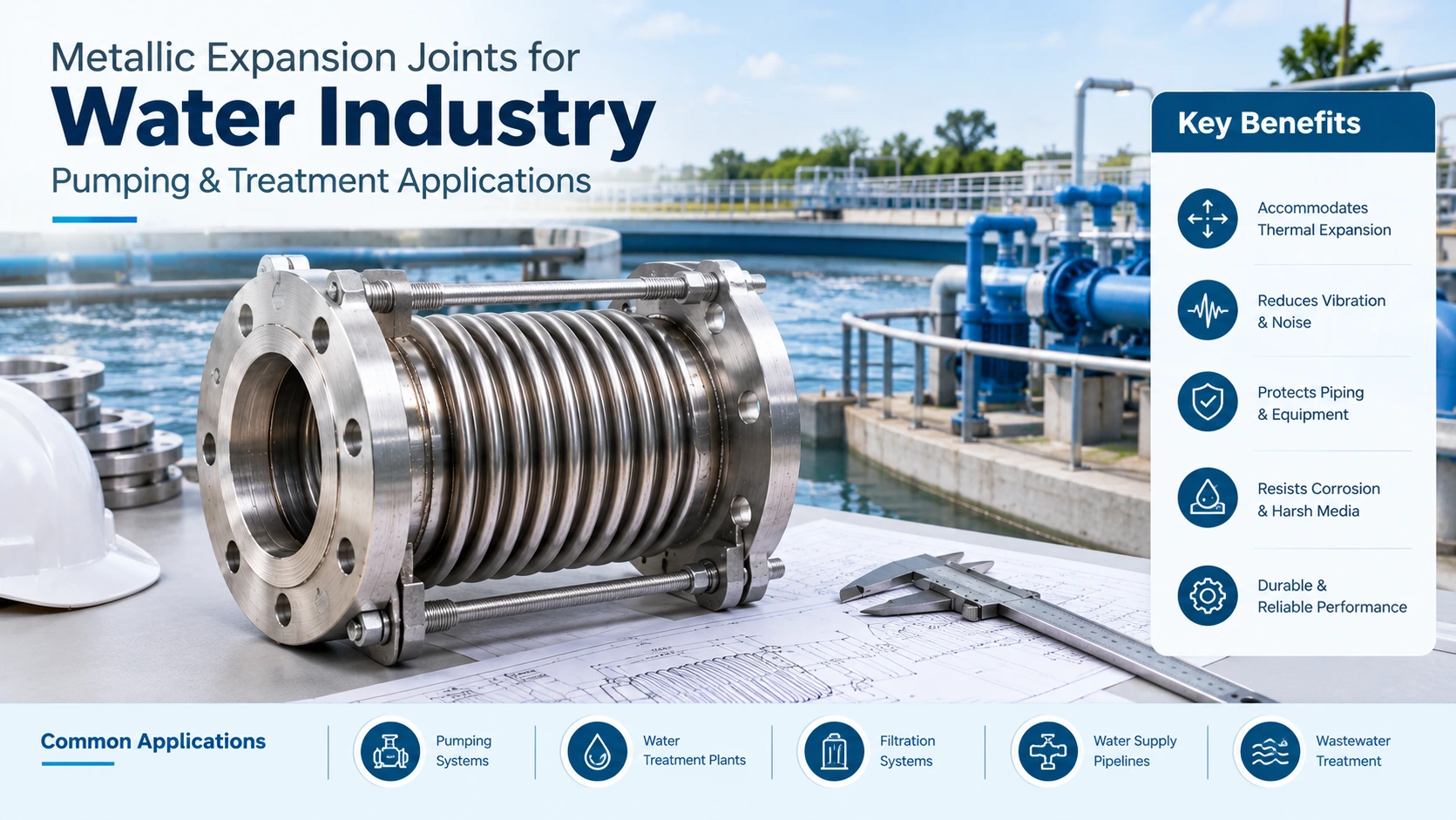

Metallic expansion joints in water industry piping mainly absorb pipeline movement from ground settlement and temperature change, and isolate vibration from pumping station equipment — with axial joints suited to long straight transmission mains and universal or gimbal joints used at direction changes and pump connections.
Where round-pipe expansion joints fit into water infrastructure
Water and wastewater networks move large volumes through predominantly round pipe — transmission mains, pumping station manifolds, and treatment plant interconnecting piping. That geometry makes metallic expansion joints (axial, universal, and gimbal types) the natural fit wherever this piping needs to absorb movement, distinct from the rectangular ducting also found in some treatment plant air-handling systems.
Pumping stations: vibration isolation is the priority
At pumping stations, the dominant design driver is usually vibration from large pump and motor sets rather than extreme thermal movement, since water temperatures don’t swing as widely as process steam or flue gas. Axial expansion joints at pump discharge and suction connections isolate that vibration from the rigid distribution piping, protecting welds and supports from years of cumulative fatigue that a rigid connection would otherwise absorb directly.
Transmission mains and treatment plant interconnecting piping
Long transmission mains, particularly where exposed above ground or crossing a structural expansion joint in a pumping station or treatment building, use axial expansion joints to absorb straight-line thermal growth. Where the pipe route changes direction or where a large-diameter connection needs to accommodate more than simple axial movement, universal or gimbal expansion joints take over — the same movement-type decision framework used across any piping system, just applied to water infrastructure’s typically lower-temperature, lower-pressure conditions.
What to specify
Operating and surge pressure (water hammer events can exceed steady-state design pressure significantly at pump start-stop), water chemistry including chloride content, vibration source and amplitude for pump isolation applications, and whether the installation is buried, in a pump room, or outdoor-exposed, since that affects material and coating requirements for the joint’s exterior.
Generally no — water temperatures don’t approach the extremes of process steam or flue gas, so the design priority is typically vibration isolation and movement from settlement rather than high-temperature capability.
Surge pressure events from water hammer at pump start-stop or valve closure can significantly exceed steady-state operating pressure, so design pressure specifications should account for expected surge conditions, not just normal flow pressure.
A universal or gimbal expansion joint is generally better suited to direction changes than a simple axial joint, depending on whether the movement is primarily lateral offset (universal) or angular rotation (gimbal) — confirm the specific movement with a pipe stress review.
Specifying metallic expansion joints for a pumping station or transmission main? Send MechFlex Bellows your pressure, vibration, and layout details for a matched recommendation.