
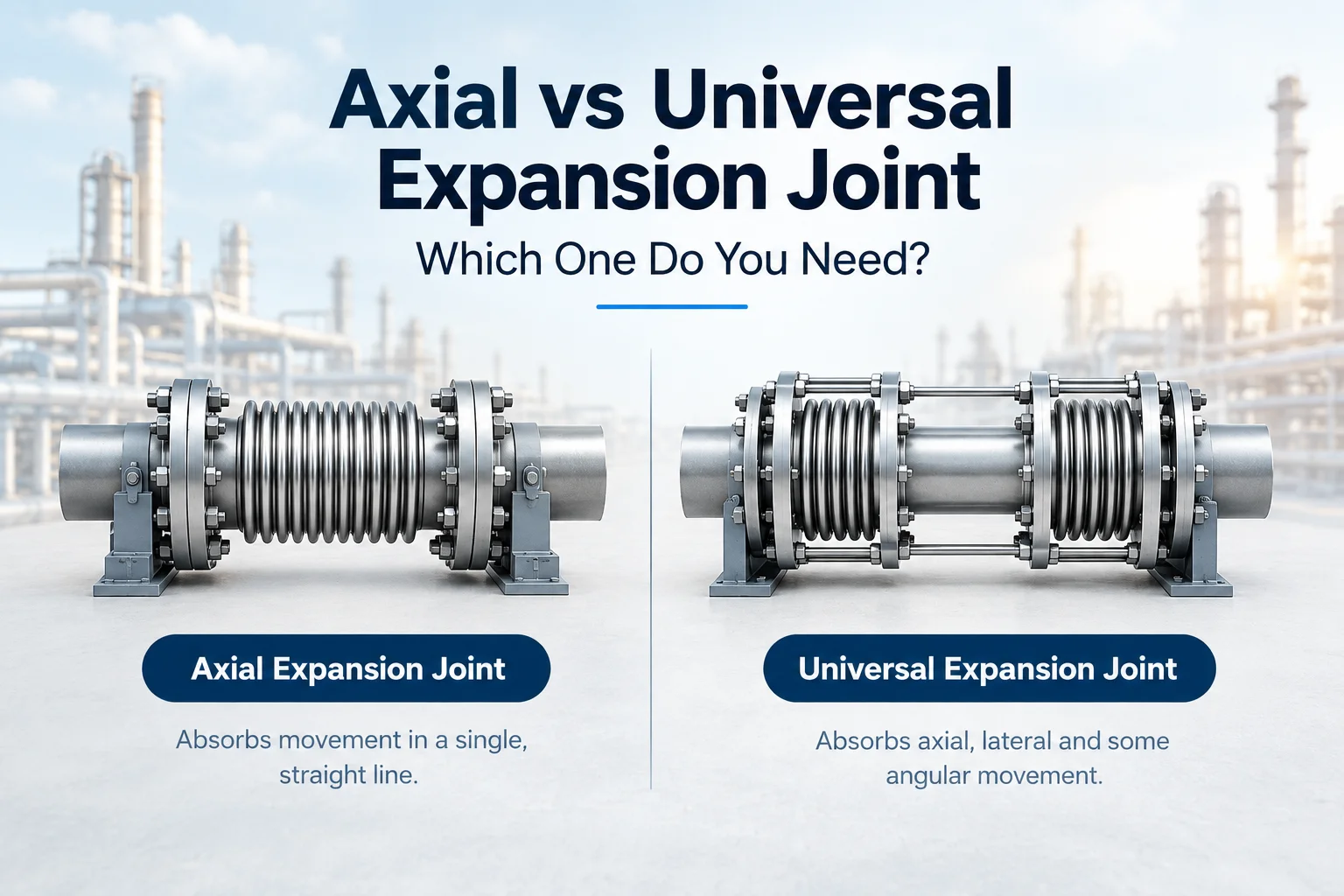

An Axial Expansion Joint absorbs movement along a single, straight line of pipe and needs main anchors on both sides. A Universal Expansion Joint uses two bellows connected by a center pipe to absorb axial, lateral, and some angular movement together, without relying on the same anchor arrangement. Choose axial for simple straight-run thermal growth; choose universal when the pipe run has to accommodate movement in more than one direction.
Two different jobs, both called ‘metallic expansion joints’
Plant engineers often use ‘metallic expansion joint’ as a catch-all term, but the specific type you specify changes how the rest of the pipeline is designed — particularly the anchors and guides around it. Getting this choice wrong doesn’t just mean a slightly-wrong part; it means anchors sized for the wrong forces, guides in the wrong places, and a joint that fatigues faster than it should.
The two most commonly confused types are the Axial Expansion Joint and the Universal Expansion Joint. Both use corrugated metal bellows to absorb pipeline movement, but the movement they’re built to handle — and what they demand from the rest of the system — is different.
Axial Expansion Joint: movement in one direction
An Axial Expansion Joint is a single bellows element designed to absorb axial movement — compression and extension along the pipe’s centerline — caused by thermal expansion and contraction of straight pipe runs. It does not absorb lateral or angular movement well, so the piping either side of it must be properly anchored and guided to keep the joint moving only in its intended direction.
Because it’s a single-bellows design, an axial joint is generally the more compact and cost-effective option when the application genuinely is straight-line thermal growth — long straight runs in steam lines, hot water lines, and process piping are the classic use case.
- Best for: long straight pipe runs with predictable axial thermal growth
- Requires: main anchors at both ends of the run, plus intermediate guides
- Watch out for: pressure thrust — axial joints generate significant force on anchors under internal pressure, which must be accounted for in anchor design
Universal Expansion Joint: movement in more than one direction
A Universal Expansion Joint pairs two bellows with a length of center pipe between them. That configuration lets it absorb axial movement and lateral (side-to-side) movement simultaneously, and it can accommodate a limited amount of angular movement too. It’s the better fit where the pipe route isn’t a single clean straight line, or where the exact movement pattern is harder to predict.
Because the two bellows share the movement between them, a universal joint can often be installed with lighter anchor requirements than an equivalent axial installation covering the same overall movement — though main anchors are still required at the ends of the piping system.
- Best for: pipe runs with offset sections, direction changes, or combined axial + lateral movement
- Requires: correctly spaced main anchors either side of the assembly; the center pipe length affects how much lateral movement it can absorb
- Watch out for: undersizing the center pipe length for the actual lateral offset needed
How to decide
Start with the pipe route, not the catalogue. If the section you’re compensating for is a genuinely straight run with only thermal growth to worry about, an axial joint is usually the simpler and more economical choice. If the route has an offset, a direction change, or you need to absorb lateral movement alongside axial growth, a universal joint does that job in a single assembly rather than requiring two separate axial joints and extra elbows.
Either way, movement values (axial, lateral, angular), design pressure, temperature, and the anchor/guide layout of the existing or planned pipe run should go to the manufacturer’s engineering team before a joint is selected — undersizing the movement capability is one of the most common causes of premature bellows failure.
In many layouts, yes — a single universal joint can absorb the combined axial and lateral movement that would otherwise need two axial joints plus additional elbows, simplifying the pipe run and reducing the number of anchor points needed.
Neither axial nor universal joints are the ideal choice for pure angular movement — that’s the job of a Gimbal Expansion Joint or a Hinged Expansion Joint. A universal joint can tolerate a small amount of angular movement, but shouldn’t be specified for significant angular requirements.
Yes. Because an axial joint generates pressure thrust along the pipe’s centerline, both main anchors must be designed to hold that force — this is one of the most frequently underestimated aspects of axial joint installation.
Not sure which movement type your pipe run actually needs? Send MechFlex Bellows your layout and movement values — we’ll recommend the right metallic expansion joint before you commit to anchor design.