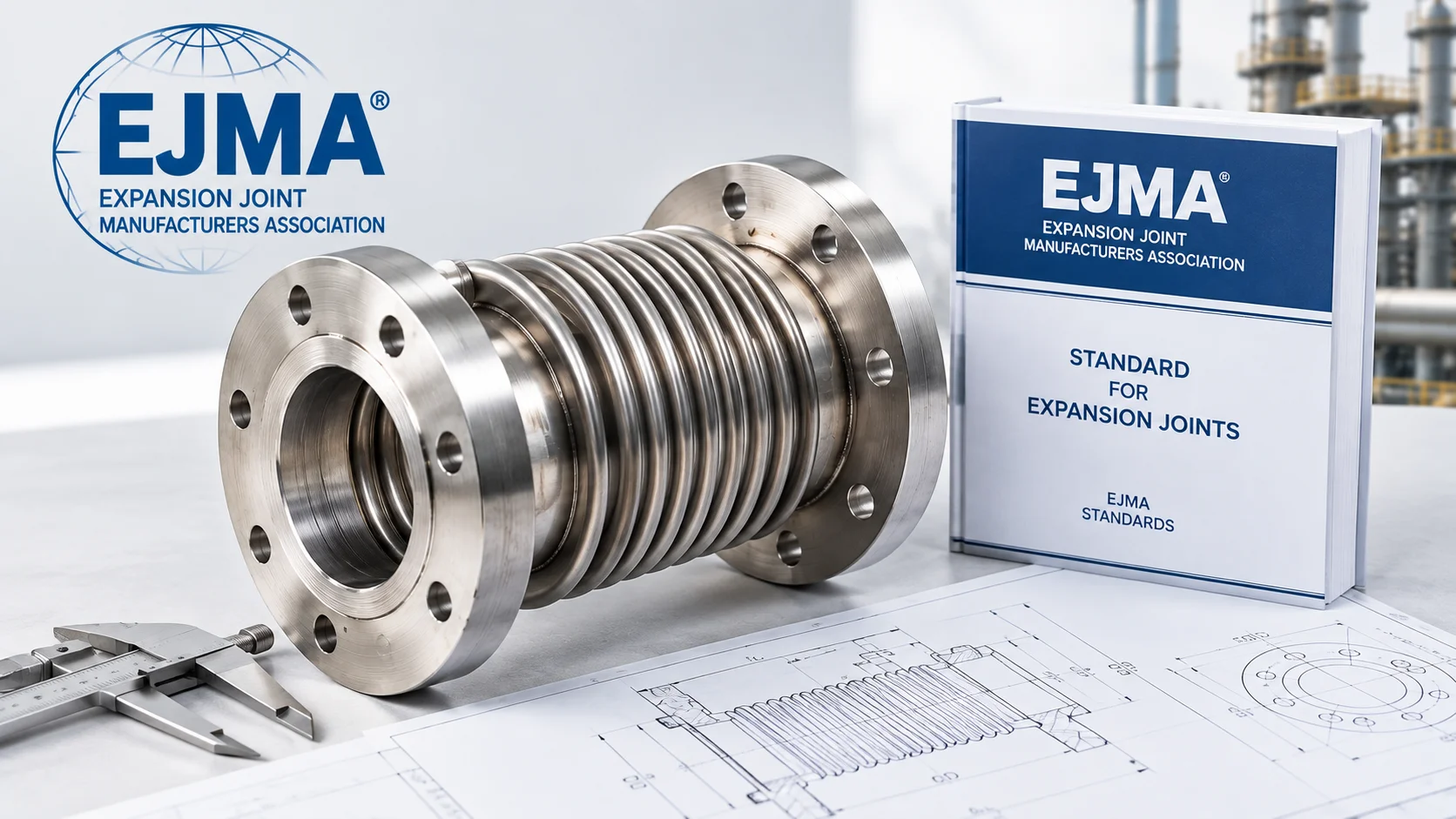

EJMA stands for the Expansion Joint Manufacturers Association, a US-based industry body whose design standard is the most widely referenced technical basis for metal bellows expansion joints worldwide. It covers bellows geometry, fatigue life calculation, spring rate, and pressure/movement limits — giving buyers a common technical language to compare joints from different manufacturers.
Why an industry standard matters for a bellows
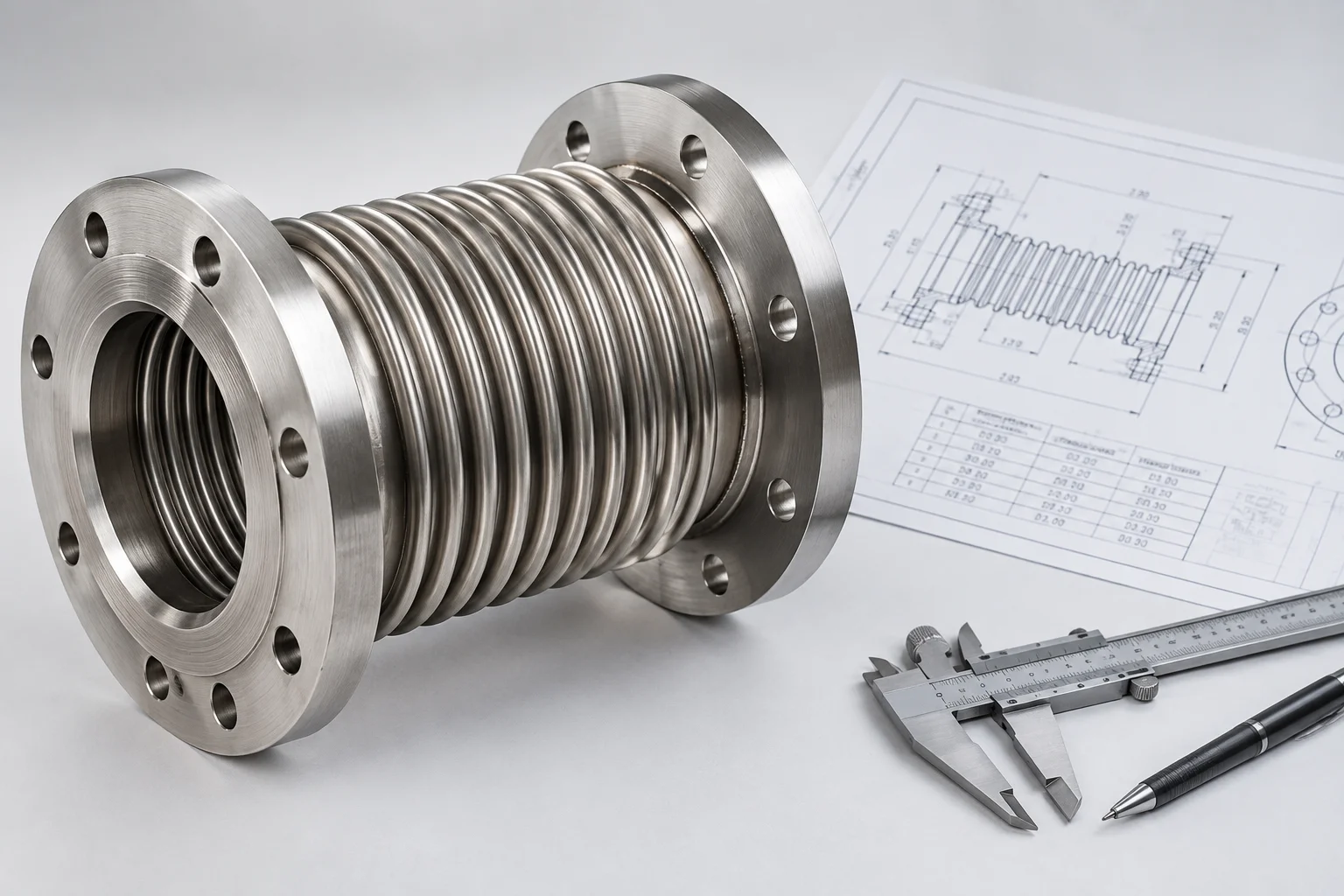
A metal expansion bellows looks simple from the outside — a corrugated metal cylinder — but the engineering behind it is not. The number of convolutions, the material thickness, the convolution shape, and the reinforcing rings all interact to determine how much movement the bellows can absorb, how many pressure cycles it will survive, and at what point it fails. Without a shared reference, every manufacturer could define ‘rated movement’ or ‘cycle life’ differently, making it almost impossible for a buyer to compare two quotations on equal terms.
That’s the gap EJMA fills. It doesn’t sell bellows; it publishes the calculation methods manufacturers use to design them.
What the EJMA standard actually covers
The EJMA Standards, published by the Expansion Joint Manufacturers Association, set out the engineering formulas for calculating a metal bellows’ spring rate, stress under pressure and movement, and predicted fatigue life in cycles. It also standardizes terminology — convolution height, pitch, root radius — so a spec sheet from one manufacturer means the same thing as a spec sheet from another.
- Fatigue life calculation — how many full movement cycles the bellows is expected to survive before failure
- Pressure capacity — the relationship between bellows geometry, material, and safe internal pressure
- Spring rate — the force required to move the bellows through its rated axial, lateral, and angular movement
- Column instability and squirm limits — the point beyond which a bellows can buckle under pressure rather than flex as intended
How to check if a joint is EJMA-designed
A genuinely EJMA-referenced design should be able to produce, on request, the calculation basis behind the movement and cycle-life figures on its spec sheet — not just the final numbers. When comparing quotations for a project, it’s reasonable to ask a supplier directly whether their bellows design follows EJMA formulas, and to ask for the fatigue life calculation for your specific pressure, temperature, and movement values rather than a generic catalogue figure.
For India-based buyers, EJMA is used alongside — not instead of — other standards. Where boiler and pressure vessel applications are involved, IBR (Indian Boiler Regulations) approval is the additional local compliance requirement; where the piping system itself is designed to ASME B31.3 or similar, the expansion joint’s EJMA-derived ratings need to align with those system-level pressure and temperature design conditions.
No — EJMA (Expansion Joint Manufacturers Association) is a US-based industry association that publishes design standards. It isn’t a government regulator, and there’s no single ‘EJMA certificate’ issued to a company; instead, manufacturers design their bellows using EJMA’s published formulas and can state their products are ‘EJMA-designed’ or ‘EJMA-referenced’.
No. ASME (American Society of Mechanical Engineers) codes govern pressure piping and vessel design broadly, while EJMA is specific to expansion joint engineering. The two are complementary — an expansion joint sits inside a piping system designed to ASME (or equivalent) codes, and its own bellows design follows EJMA formulas.
EJMA-based calculation is good practice at any pressure, but it becomes non-negotiable as pressure, temperature, and expected cycle count increase — this is where undersized bellows are most likely to fail early.


One Reply to “What Is the EJMA Standard for Expansion Joints?”
IBR Approval for Industrial Bellows Explained | MechFlex, 22/09/2026
[…] EJMA (an industry design standard) or ISO (a voluntary quality management certification), IBR — the […]
Comments are closed.