
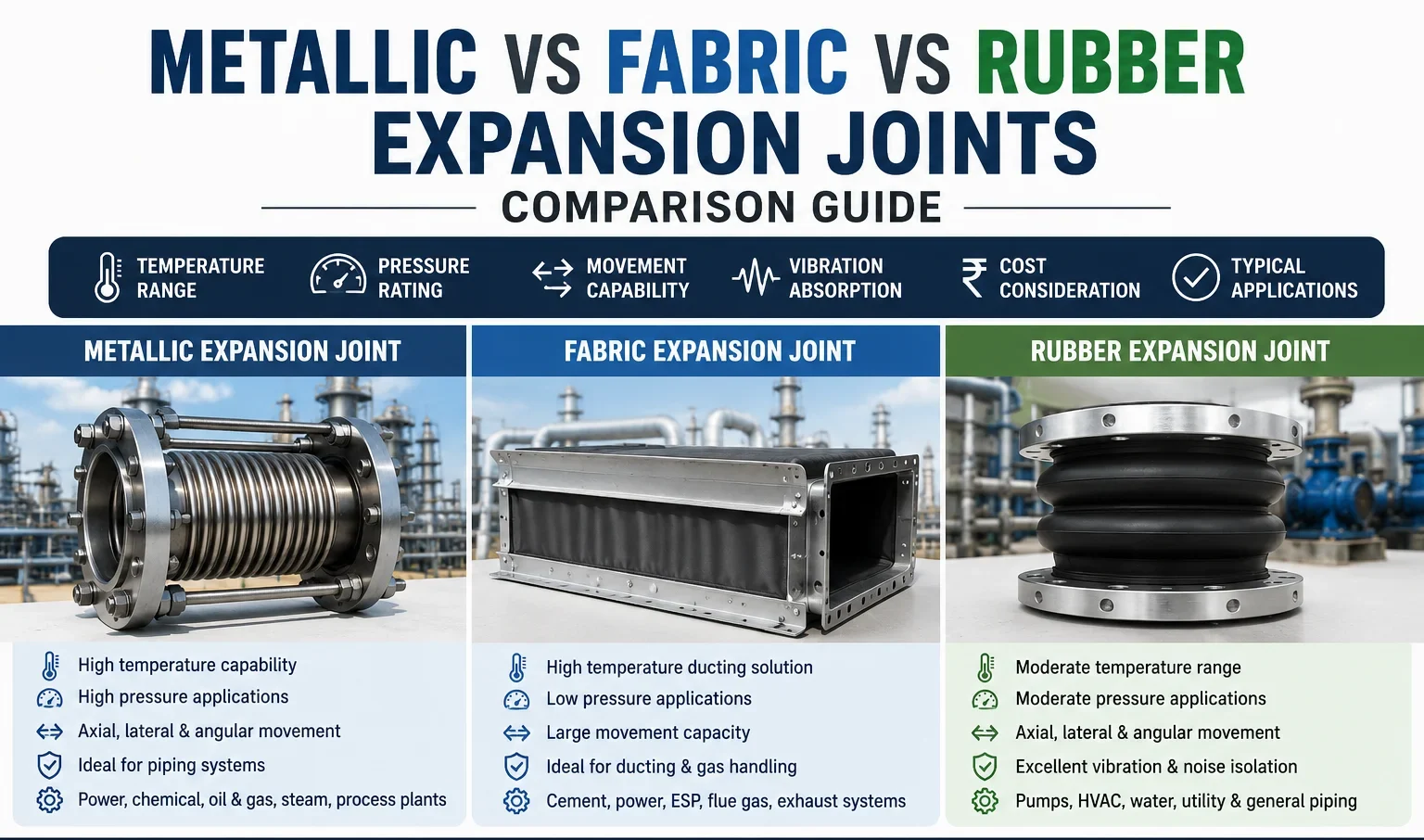

Metallic, fabric, and rubber expansion joints are designed for different operating conditions and system requirements. Metallic expansion joints are commonly selected for demanding piping systems involving pressure, temperature, and controlled movement. Fabric expansion joints are primarily used in industrial ducting and gas-handling systems where thermal movement and larger displacement need to be accommodated. Rubber expansion joints are often selected for vibration isolation, noise reduction, and flexible connections in piping systems.
Choosing the right expansion joint depends on factors such as operating temperature, pressure, movement, media, pipe or duct configuration, vibration, and installation conditions.
Metallic vs Fabric vs Rubber Expansion Joints
| Feature | Metallic Expansion Joints | Fabric Expansion Joints | Rubber Expansion Joints |
|---|---|---|---|
| Construction | Corrugated metallic bellows | Flexible fabric and insulation layers | Flexible elastomer/rubber body |
| Typical system | Industrial piping | Industrial ducting and gas-handling systems | Industrial piping |
| Pressure capability | Suitable for pressure applications, design-dependent | Generally suited to low-pressure ducting applications | Application and design-dependent |
| Temperature capability | Suitable for high-temperature applications, depending on material and design | Suitable for high-temperature ducting, depending on construction | Application and material-dependent |
| Vibration absorption | Good | Good | Excellent |
| Movement | Axial, lateral, angular, or combined depending on design | Axial, lateral, and angular movement depending on design | Axial, lateral, and angular movement depending on design |
| Main purpose | Thermal expansion, movement, and piping stress control | Thermal movement, vibration, and duct displacement | Vibration isolation, noise reduction, and flexible movement |
| Typical applications | Power, chemical, petrochemical, steam, process piping | ESP, cement, power, exhaust, and flue gas ducting | Pumps, HVAC, water, and industrial piping |
| Material selection | Based on pressure, temperature, and media | Based on temperature, media, and duct conditions | Based on temperature, media, pressure, and flexibility |
| Selection priority | Pressure, temperature, movement, and media | Temperature, movement, duct configuration, and media | Vibration, movement, pressure, temperature, and media |
What Are Metallic Expansion Joints?
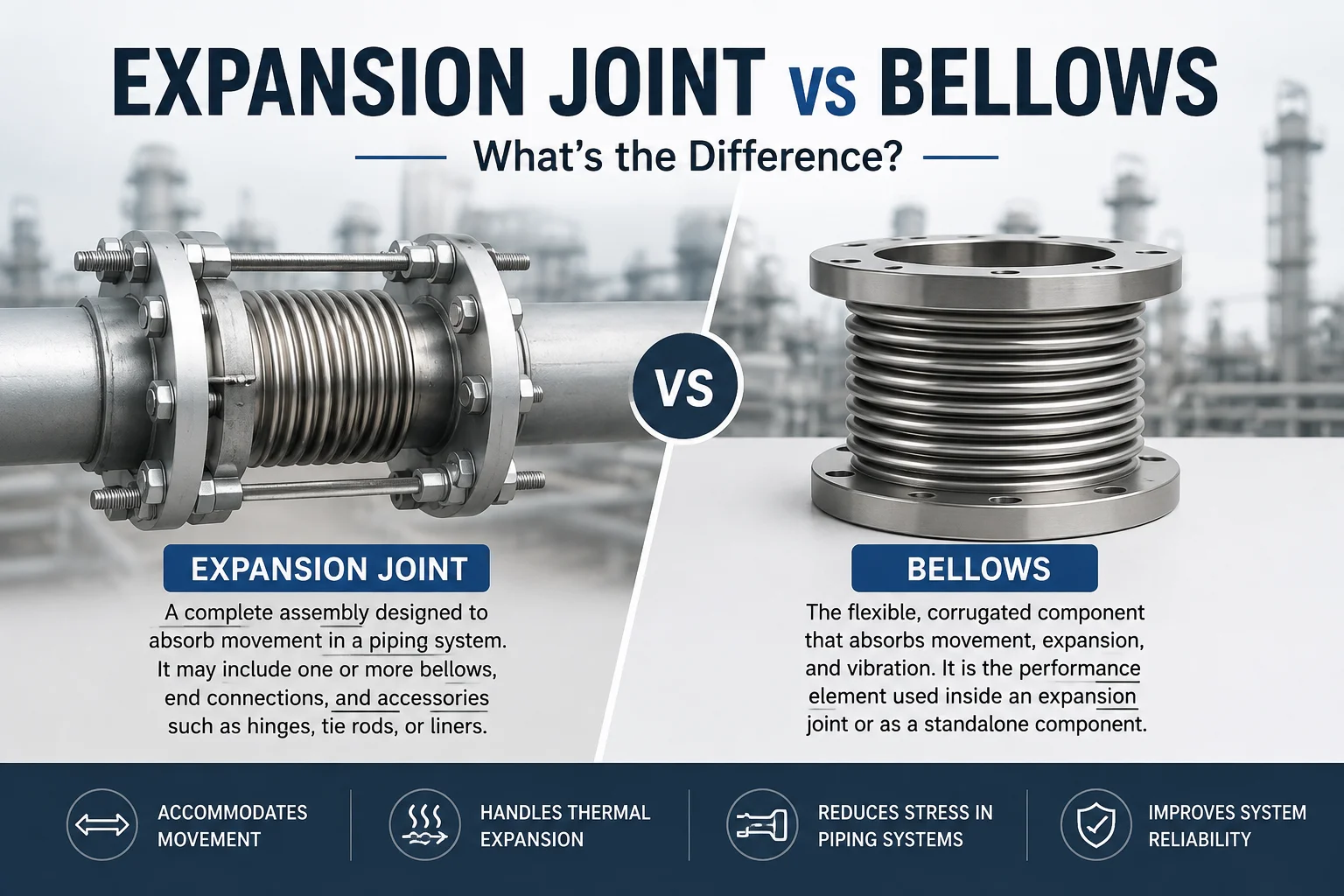
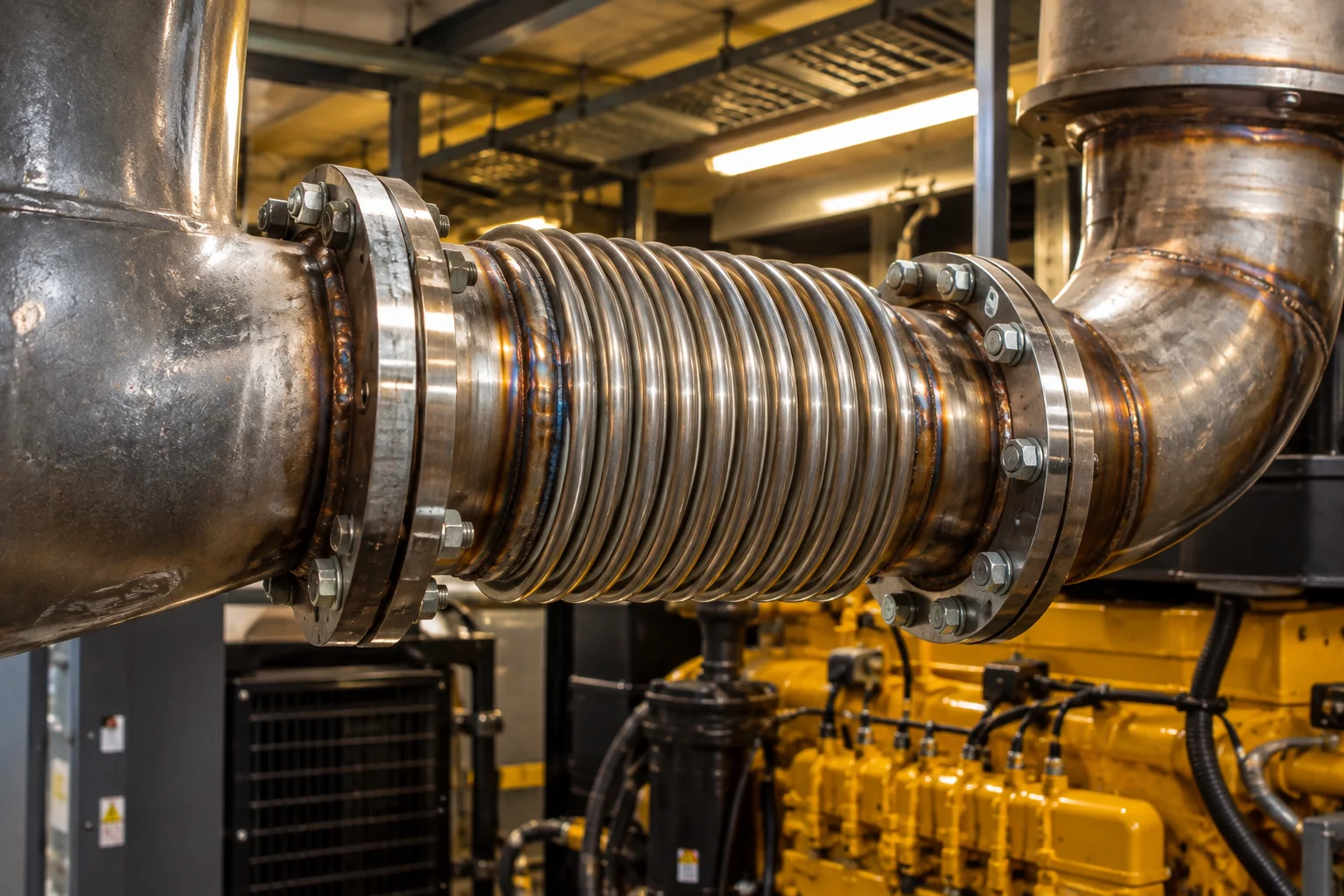
Metallic expansion joints use a flexible corrugated metallic bellows as the primary movement-absorbing element. They are commonly used in industrial piping systems where thermal expansion, vibration, equipment movement, or pipe displacement can create stress in connected components.
Depending on the application, metallic expansion joints can be designed for axial, lateral, angular, or combined movement. Different configurations include axial, universal, hinged, gimbal, and pressure-balanced expansion joints.
Material selection is an important part of metallic expansion joint design because the bellows must withstand the operating temperature, pressure, process media, and environmental conditions of the application.
Common Metallic Expansion Joint Applications
- Power generation plants
- Chemical processing plants
- Petrochemical facilities
- Oil and gas systems
- Steam and boiler systems
- Cement and steel plants
- Industrial process pipelines
- Pumping and mechanical equipment connections
Explore: Metallic Expansion Joints
What Are Fabric Expansion Joints?
Fabric expansion joints are flexible non-metallic expansion components primarily used in industrial ducting and gas-handling systems. They are designed to accommodate thermal movement, vibration, structural displacement, and other movement between connected duct sections or equipment.
Unlike metallic expansion joints, fabric designs are commonly used where the system involves large duct dimensions and relatively low-pressure gas or air movement. Their construction can include different fabric, insulation, and reinforcement layers selected according to operating temperature, media, movement, and environmental conditions.
Common Fabric Expansion Joint Applications
- Power plant ducting
- ESP systems
- Cement plants
- Flue gas systems
- Industrial exhaust systems
- Boiler ducting
- Furnace systems
- HVAC and air-handling systems
- High-temperature process ducting
Explore: Fabric Expansion Joint
What Are Rubber Expansion Joints?
Rubber expansion joints are flexible connectors manufactured using elastomeric materials. They are commonly used in piping systems where vibration isolation, noise reduction, flexibility, and compensation for minor movement are important.
Rubber expansion joints can help isolate vibration generated by pumps, compressors, and other rotating equipment while reducing the transmission of mechanical noise through connected piping. Their material and construction should be selected according to the operating temperature, pressure, process media, and movement requirements.
Common Rubber Expansion Joint Applications
- Pumping systems
- HVAC systems
- Water pipelines
- Cooling water systems
- Industrial process piping
- Chemical applications
- Mechanical equipment connections
- Utility piping systems
Explore: Rubber Expansion Joint
Metallic vs Fabric vs Rubber: Which Expansion Joint Should You Choose?
There is no single expansion joint type that is suitable for every industrial application. The correct selection depends on the conditions under which the joint will operate.
Choose a Metallic Expansion Joint When:
- The system involves significant pressure
- High operating temperatures need to be accommodated
- The application requires controlled axial, lateral, or angular movement
- The joint is installed in industrial process piping
- The system requires a metallic bellows construction
- Thermal expansion is a major design consideration
Choose a Fabric Expansion Joint When:
- The application involves industrial ducting
- Flue gas or hot air movement is involved
- Large duct movements need to be accommodated
- The system operates at relatively low pressure
- High-temperature ducting requires a flexible connection
- The application involves ESP, cement, power, or exhaust systems
Choose a Rubber Expansion Joint When:
- Vibration isolation is a major requirement
- Noise reduction is important
- Pumps or rotating equipment are connected to the piping
- Flexible piping connections are required
- The application involves water, HVAC, or utility systems
- The selected elastomer is compatible with the process media
Key Factors When Selecting an Expansion Joint
Before selecting an expansion joint, evaluate the complete operating and installation conditions.
1. Operating Temperature
Temperature affects material selection and the overall construction of the expansion joint. High-temperature applications may require specialized metallic or fabric constructions depending on whether the system is piping or ducting.
2. Operating Pressure
Pressure is particularly important for piping applications. The expansion joint must be designed according to the system pressure and required safety conditions.
3. Required Movement
Determine whether the system requires:
- Axial movement
- Lateral movement
- Angular movement
- Combined movement
The required movement will influence the appropriate expansion joint configuration.
4. Process Media
The material of the expansion joint must be compatible with the fluid, gas, chemicals, or other media passing through the system.
5. Vibration
If the connected equipment generates significant vibration, vibration isolation should be considered during expansion joint selection. Rubber expansion joints can be particularly useful in applications where vibration and noise isolation are important.
6. Pipe or Duct Configuration
The application may involve a round pipe, rectangular duct, equipment connection, or complex piping arrangement. The available installation space and connection configuration should be considered before selecting the joint.
7. Installation Conditions
Installation space, anchor points, guides, supports, movement direction, and connected equipment can all influence the appropriate expansion joint design.
Metallic, Fabric, or Rubber Expansion Joint: Quick Selection Guide
| If your main requirement is… | Consider |
|---|---|
| High-pressure industrial piping | Metallic Expansion Joint |
| High-temperature process piping | Metallic Expansion Joint |
| Axial pipe movement | Metallic Expansion Joint |
| Complex angular piping movement | Metallic Expansion Joint |
| High-temperature industrial ducting | Fabric Expansion Joint |
| Flue gas or ESP ducting | Fabric Expansion Joint |
| Large duct movement | Fabric Expansion Joint |
| Pump vibration isolation | Rubber Expansion Joint |
| Noise reduction in piping | Rubber Expansion Joint |
| Flexible water/HVAC connections | Rubber Expansion Joint |
Why Proper Expansion Joint Selection Matters
Selecting an expansion joint based only on pipe size or temperature can result in an unsuitable solution. The complete operating environment should be considered, including pressure, temperature, movement, media, vibration, connection type, and installation conditions.
A properly selected expansion joint helps accommodate expected system movement while reducing unwanted stress on connected piping, ducting, equipment, and supports.
Frequently Asked Questions
No. Each type is designed for different operating conditions and applications. Metallic expansion joints are commonly used in industrial piping, fabric expansion joints are primarily used in ducting systems, and rubber expansion joints are frequently selected for vibration isolation and flexible piping connections.
The appropriate type depends on whether the application involves piping or ducting, as well as the actual temperature, pressure, media, and movement requirements. Metallic expansion joints can be suitable for high-temperature piping, while fabric expansion joints are commonly used in high-temperature industrial ducting.
Rubber expansion joints are commonly selected where vibration isolation and noise reduction are important. However, the appropriate solution depends on the equipment, piping arrangement, operating conditions, and required movement.
Fabric expansion joints are primarily used in ducting and gas-handling systems rather than pressurized liquid piping. They are commonly found in applications such as flue gas, exhaust, ESP, boiler, cement, and power plant ducting.
Selection should consider operating pressure, temperature, movement type and amount, process media, pipe or duct size, vibration, connection configuration, and installation conditions. Providing these details to the manufacturer helps determine the appropriate expansion joint design.
Need Help Selecting the Right Expansion Joint?
Every industrial application has different operating and movement requirements. MechFlex can help identify a suitable expansion joint based on your system conditions and application requirements.
Request a Quote and share your pipe or duct size, operating pressure, temperature, movement requirements, media, quantity, and other available technical details with the MechFlex team.


Leave A Comment