
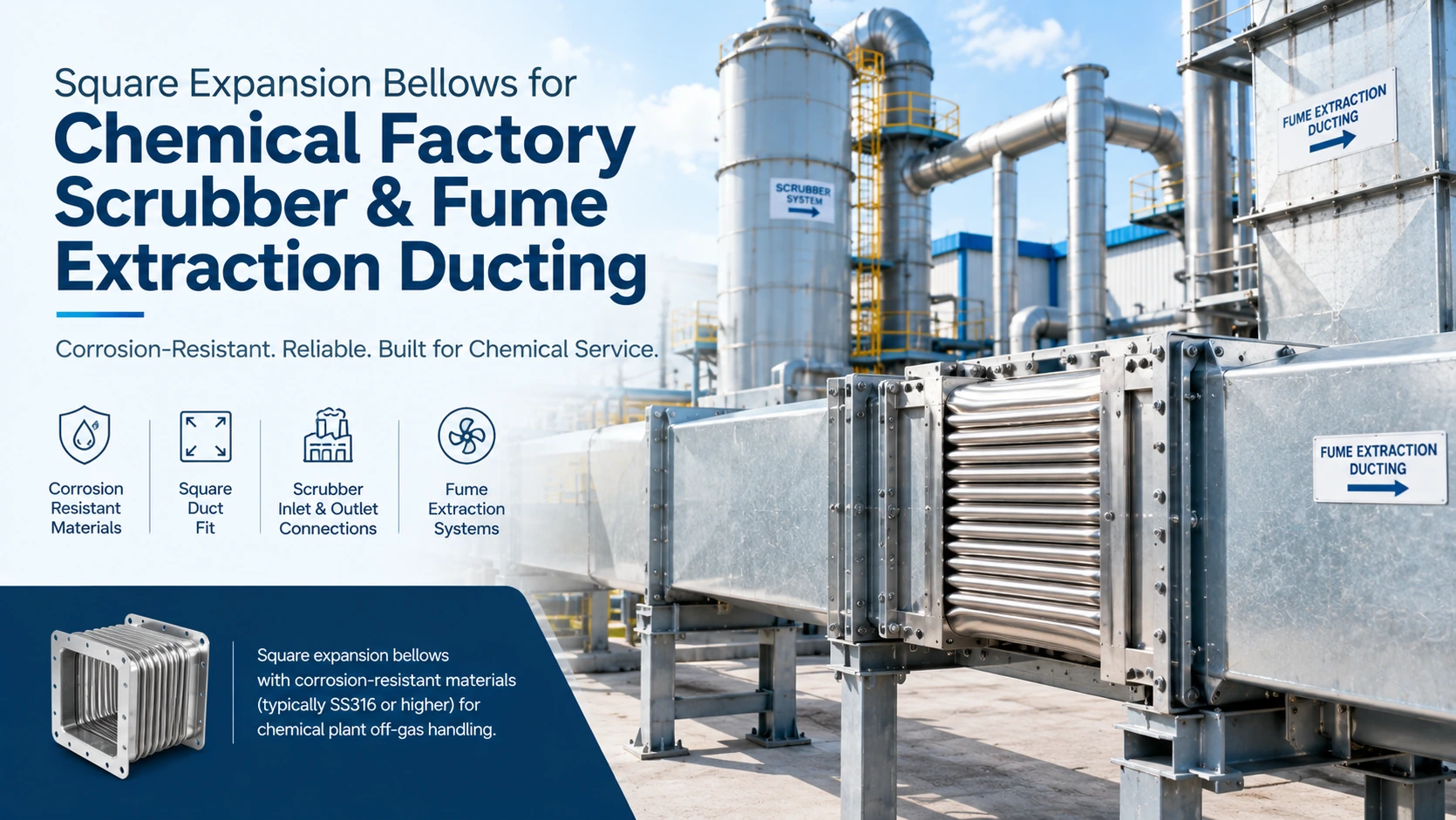

Square expansion bellows connect scrubber and fume extraction ducting in chemical plants where the duct cross-section is square rather than elongated rectangular, with corrosion-resistant material selection — often SS316 or higher — mattering as much as the standard square-duct reinforcement considerations.
Square ducting alongside rectangular in chemical plants
Chemical plant off-gas handling — scrubbers treating corrosive vapor before release, fume extraction protecting workspace air quality — runs through both rectangular and square ducting depending on the specific equipment footprint and space available. Where the cross-section works out to equal sides, a square expansion bellows is the correct fit, following the same underlying corrosion and reinforcement principles as its rectangular counterpart but with the more evenly distributed structural behavior that equal-sided geometry provides.
Scrubber inlet and outlet connections
Scrubber systems treat acidic or otherwise corrosive gas streams before they’re released, and the ducting immediately before and after the scrubber vessel often carries the most concentrated version of whatever the scrubber is designed to remove. Square expansion bellows at these connections need material selected for that peak concentration, not an average figure, since scrubber inlet conditions are frequently more aggressive than the general plant off-gas composition.
Fume extraction systems
General fume extraction ducting, protecting workspace air quality rather than treating a specific process stream, typically deals with lower concentration but broader, more variable chemical exposure across different capture points feeding into a common duct. Material selection here should account for the range of chemicals the system might capture across its various pickup points, not just the primary process chemical at any single point.
What to specify
Exact duct dimensions, the specific corrosive gas composition and concentration at the connection point (scrubber inlet concentration is typically higher than outlet or general extraction ducting), operating temperature and pressure/vacuum, and whether upset or emergency conditions could expose the duct to different, more aggressive chemistry than routine operation.
Generally yes — scrubber inlet ducting typically carries the gas stream before treatment, at its most concentrated, while outlet ducting carries the treated, lower-concentration gas, though this should be confirmed against your specific scrubber’s design and removal efficiency.
Not necessarily — different capture points feeding into a common extraction duct can expose different sections to different chemical concentrations, so material selection is sometimes graded across the system rather than uniform throughout.
Yes — the same tie rod and stiffening principles apply, though square geometry’s more even load distribution generally means reinforcement needs are somewhat less severe than an elongated rectangular joint of similar size and pressure.
Have scrubber or fume extraction ducting to specify? Share the gas composition and duct dimensions with MechFlex Bellows for a square expansion bellows recommendation.