
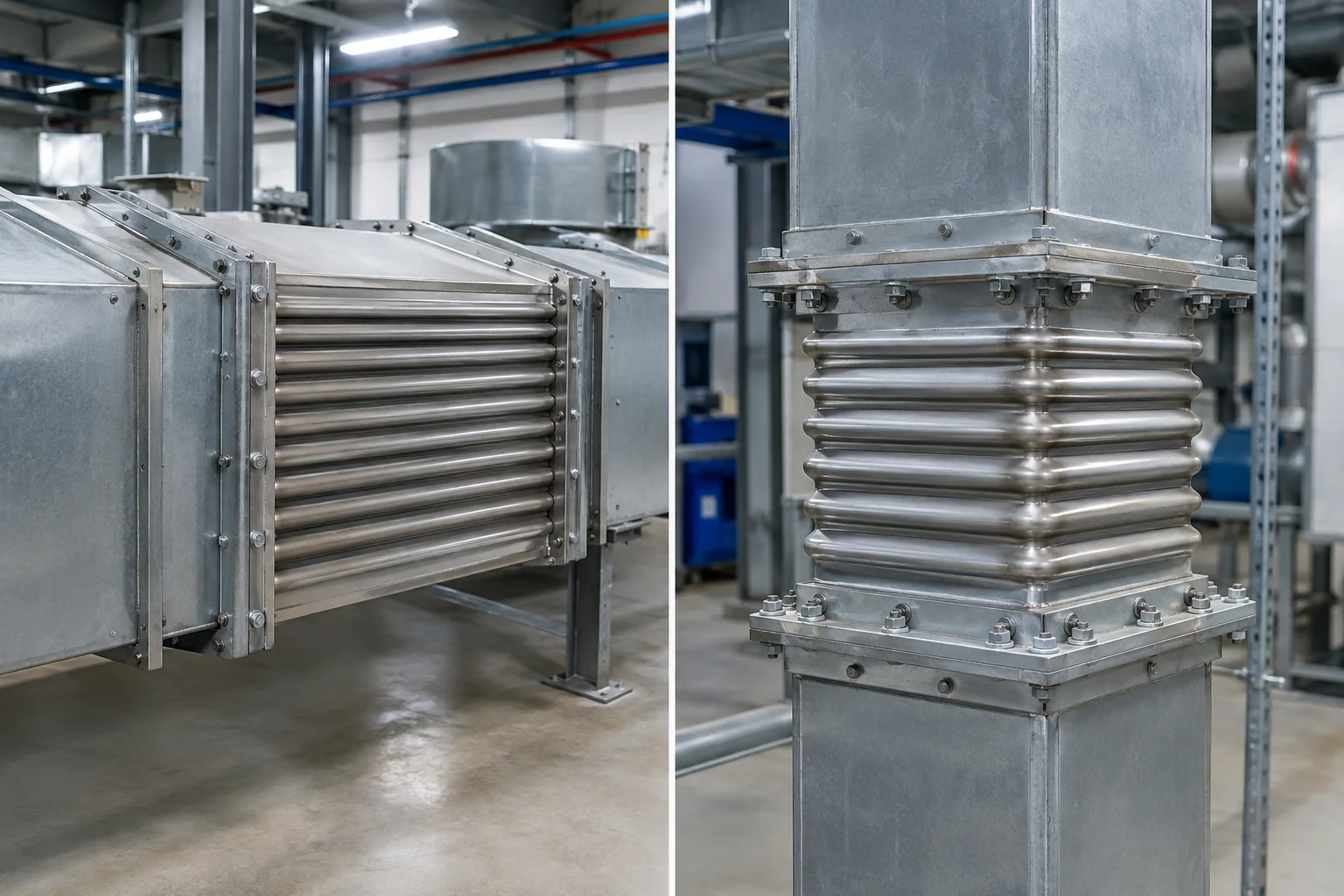

Rectangular and square expansion bellows solve the same basic problem — absorbing thermal movement, vibration, and misalignment in ducting systems — but the shape of your duct usually decides which one you need. Choosing the wrong profile leads to poor sealing, uneven stress distribution, and premature fatigue failure at the corners. Here’s how to tell them apart and pick correctly.
What Is a Rectangular Expansion Bellows?
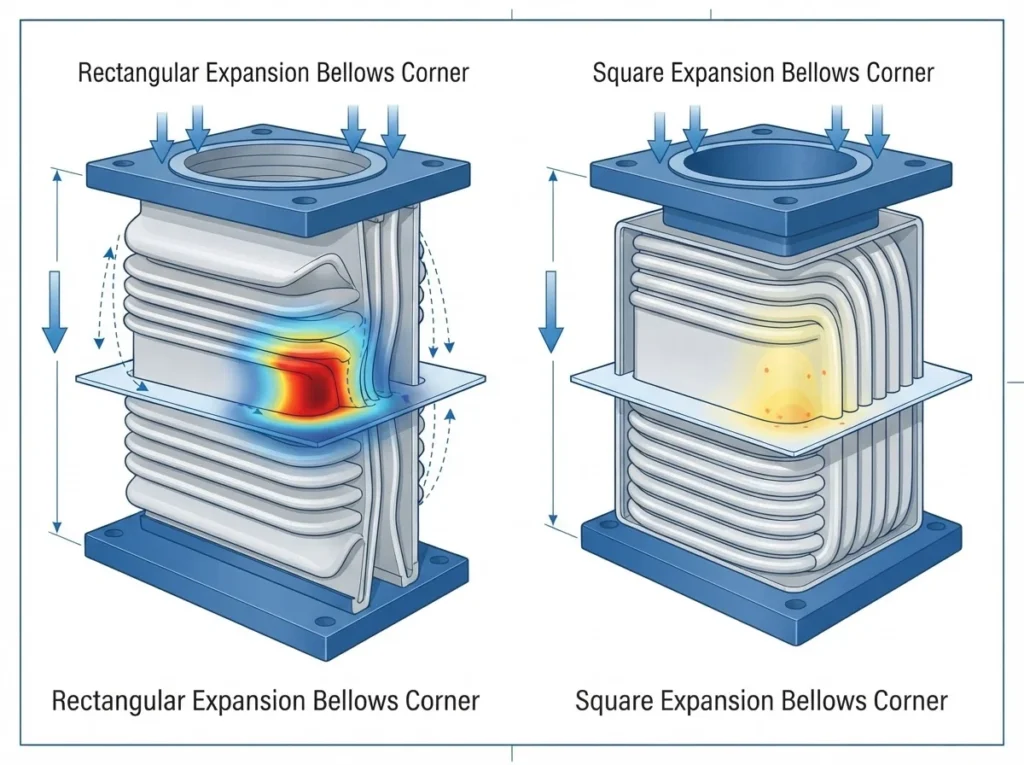
A rectangular expansion bellows has unequal side lengths (for example, a wide-but-shallow duct cross-section). It’s built to match non-square ducting exactly, so the flexible element absorbs movement uniformly across both the long and short sides without over-stressing the corners — which is typically where rectangular bellows are most vulnerable if the design doesn’t account for the aspect ratio.
Typically used for: wide, shallow ducts common in air-handling units, ESP (electrostatic precipitator) inlet/outlet ducts, and large industrial exhaust runs where the duct cross-section is naturally elongated.
What Is a Square Expansion Bellows?
A square expansion bellows has equal side lengths. Because the geometry is symmetrical, movement and stress are distributed evenly on all four sides, which generally makes square bellows more straightforward to design and fabricate for a given size — corner reinforcement requirements are more predictable.
Typically used for: compact ducting runs, boiler and furnace duct connections, and smaller HVAC or process-gas ducts where the cross-section is naturally square or near-square.
Key Differences at a Glance
| Factor | Rectangular Expansion Bellows | Square Expansion Bellows |
|---|---|---|
| Duct shape fit | Non-square, elongated ducts | Square or near-square ducts |
| Stress distribution | Uneven — long sides move differently than short sides | Even — symmetrical on all sides |
| Corner design complexity | Higher — corners need reinforcement calculated for the aspect ratio | Lower — more predictable corner behavior |
| Common installations | ESP ducts, wide air-handling ducts, large exhaust runs | Boiler/furnace ducts, compact HVAC runs |
| Typical fabrication | Custom per aspect ratio | Often more standardized for a given size |
How to Choose Between Them
- Match your existing duct cross-section first. This is non-negotiable — the bellows has to physically fit the flange dimensions of the duct it’s replacing or connecting.
- Consider the movement type. If the duct experiences more movement along one axis than the other (common in long, wide ducts), a rectangular bellows engineered specifically for that aspect ratio will outperform a “stretched square” design.
- Factor in the operating environment. High dust-load or corrosive-gas ducts (cement kilns, ESP systems) often favor whichever shape matches the existing plant ducting standard, since retrofitting duct geometry itself is far more expensive than sourcing a custom bellows.
- Get the corner design reviewed. For both shapes, but especially rectangular, ask your supplier to confirm the corner reinforcement is calculated for your specific dimensions — this is the most common point of premature failure if it’s treated as an afterthought.
Common Industrial Applications
- ESP (Electrostatic Precipitator) systems — rectangular bellows are common at ESP inlet/outlet ducts due to the naturally elongated duct cross-section
- Cement plant kiln and preheater ducts — both shapes appear depending on the specific duct run
- HVAC and air-handling systems — square bellows are common in compact plant-room ducting
- Boiler and furnace connections — square bellows are frequently used where duct cross-sections are naturally square
Not directly — the flange dimensions have to match your existing duct. If your duct cross-section is rectangular, a square bellows won’t seal or fit correctly without modifying the ducting itself.
Neither is inherently “higher capacity” — movement capacity depends on the bellows depth, material, and number of convolutions, not the shape alone. Shape determines fit and stress distribution, not maximum movement.
Generally yes, because corner fabrication and reinforcement calculations add complexity compared to a round bellows of the same size — but for rectangular/square ducting, they’re the only practical fit.
MechFlex Bellows manufactures both rectangular expansion bellows and square expansion bellows engineered to match your exact duct dimensions. Contact us with your duct specifications for a custom recommendation.



Leave A Comment